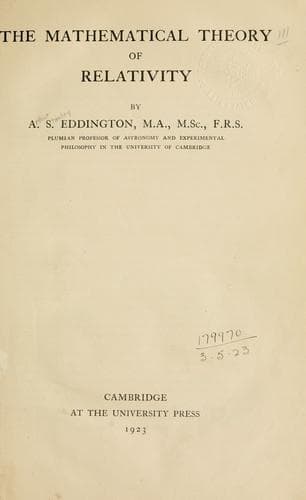
The Mathematical Theory of RelativityEddington, Arthur Stanley, Sir
Science
The Mathematical Theory of Relativity
Eddington, Arthur Stanley, Sir
Relativity (Physics)
The reader may feel that there is still some doubt as to the rigour of this
justification of the neglect of~$m^{2}$\footnotemark.\footnotetext
{To illustrate the difficulty, what exactly does $\rho_{0}$ mean, assuming that it is not defined by
\Eq{(46.6)} and~\Eq{(46.7)}? If the particles do not interfere with each other's fields, $\rho_{0}$~is $\sum m$~per unit
volume; but if we take account of the interference, $m$~is undefined---it is the constant of integration
of an equation which does not apply. Mathematically, we cannot say what $m$~would have
been if the other particles had been removed; the question is nonsensical. Physically we could
no doubt say what would have been the masses of the atoms if widely separated from one another,
and compare them with the gravitational power of the atoms under actual conditions; but that
involves laws of atomic structure which are quite outside the scope of the argument.}
Lest he attach too great importance to the
matter, we may state at once that the subsequent developments will not be
based on this investigation. In the next chapter we shall arrive at the same
formulae by a different line of argument, and proceed in the reverse direction
from the laws of continuous matter to the particular case of an isolated
particle.
The equation~\Eq{(46.2)} is a useful expression for the gravitational field due
\index{Stress-system!gravitational field due to}%
to a static distribution of mass. It is only a first approximation correct to the
order~$m/r$, but \emph{no second approximation exists} except in the case of a solitary
particle. This is because when more than one particle is present accelerations
necessarily occur, so that there cannot be an exact solution of Einstein's
equations corresponding to a number of particles continually at rest. It follows
that any constraint which could keep them at rest must necessarily be of such
a nature as to contribute a gravitational field on its own account.
Public-domain text, read in full here on John Shaqi.
Reviews
Reviews
No reviews yet
Be the first to share your thoughts on this work.
Elsewhere in the archive
Join the Discussion
Join the discussion
Sign in to leave a comment or review.
Sign InorCreate an account