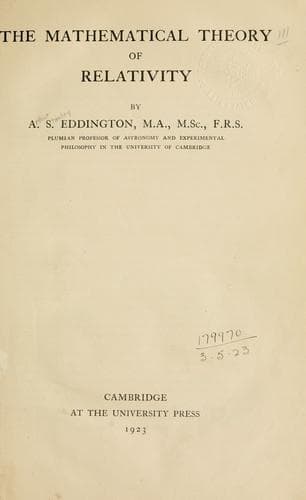
The Mathematical Theory of RelativityEddington, Arthur Stanley, Sir
Science
The Mathematical Theory of Relativity
Eddington, Arthur Stanley, Sir
Relativity (Physics)
It will be useful to give the values of $G_{\mu\nu} - \frac{1}{2} g_{\mu\nu} G$ corresponding to the
symmetrical formula for the interval~\Eq{(38.2)}. By varying $\lambda$~and $\nu$ this can represent
any distribution of continuous matter with spherical symmetry. We have
\[
G = -e^{-\lambda} \bigl(\nu'' - \tfrac{1}{2}\lambda'\nu' + \tfrac{1}{2}\nu'^{2} + 2(\nu' - \lambda')/r + 2(1 - e^{\lambda})/r^{2}\bigr)\Add{,}
\]
\[\left.
\begin{aligned}
&G_{11} - \tfrac{1}{2} g_{11} G
= -\nu'/r - (1 - e^{\lambda})/r^{2}\Add{,} \\
&G_{22} - \tfrac{1}{2} g_{22} G
= -r^{2} e^{-\lambda} \bigl(\tfrac{1}{2}\nu'' - \tfrac{1}{4}\nu'\lambda' + \tfrac{1}{4}\nu'^{2} + \tfrac{1}{2}(\nu' - \lambda')/r\bigr)\Add{,} \\
&G_{33} - \tfrac{1}{2} g_{33} G
= -r^{2}\sin^{2}\theta\, e^{-\lambda} \bigl(\tfrac{1}{2}\nu'' - \tfrac{1}{4}\nu'\lambda' + \tfrac{1}{4}\nu'^{2} + \tfrac{1}{2}(\nu' - \lambda')/r\bigr)\Add{,} \\
&G_{44} - \tfrac{1}{2} g_{44} G
= \Neg e^{\nu-\lambda} \bigl(-\lambda'/r + (1 - e^{\lambda})/r^{2}\bigr)\Add{.}
\end{aligned}
\right\}
\Tag{(46.9)}
\]
\Section{47.}{Experiment and deductive theory}
\index{Postulates, list of}%
So far as I am aware, the following is a complete list of the postulates
which have been introduced into our mathematical theory up to the present
stage:
1. The fundamental hypothesis of \SecRef{1}.
2. The interval depends on a quadratic function of four coordinate-differences
(\SecRef{2}).
3. The path of a freely moving particle is in all circumstances a geodesic
(\SecRef{15}).
4. The track of a light-wave is a geodesic with $ds = 0$ (\SecRef{15}).
5. The law of gravitation for empty space is $G_{\mu\nu} = 0$, or more probably
$G_{\mu\nu} = \lambda g_{\mu\nu}$, where $\lambda$~is a very small constant (\SecRef{37}).
\PageSep{105}
No.~4 includes the identification of the velocity of light with the fundamental
velocity, which was originally introduced as a separate postulate in \SecRef{6}.
In the mathematical theory we have two objects before us---to examine
how we may test the truth of these postulates, and to discover how the laws
which they express originate in the structure of the world. We cannot neglect
either of these aims; and perhaps an ideal logical discussion would be divided
into two parts, the one showing the gradual ascent from experimental evidence
to the finally adopted specification of the structure of the world, the other
starting with this specification and deducing all observational phenomena.
The latter part is specially attractive to the mathematician for the proof may
be made rigorous; whereas at each stage in the ascent some new inference or
generalisation is introduced which, however plausible, can scarcely be considered
incontrovertible. We can show that a certain structure will explain
all the phenomena; we cannot show that nothing else will.
Public-domain text, read in full here on John Shaqi.
Reviews
Reviews
No reviews yet
Be the first to share your thoughts on this work.
Elsewhere in the archive
Join the Discussion
Join the discussion
Sign in to leave a comment or review.
Sign InorCreate an account