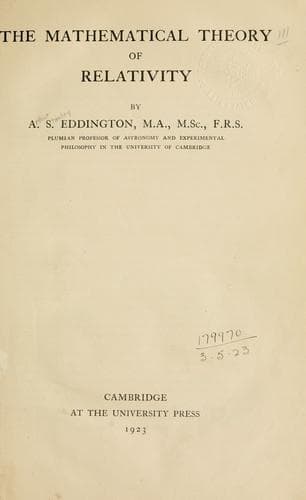
The Mathematical Theory of RelativityEddington, Arthur Stanley, Sir
Science
The Mathematical Theory of Relativity
Eddington, Arthur Stanley, Sir
Relativity (Physics)
Consider a tensor of the fourth rank $E^{\alpha\beta\gamma\delta}$ which is antisymmetrical for
all pairs of suffixes. Any component with two suffixes alike must be zero,
since by the rule of antisymmetry $E^{\alpha\beta11} = -E^{\alpha\beta11}$. In the surviving components,
$\alpha$, $\beta$, $\gamma$, $\delta$, being all different, must stand for the numbers $1$, $2$, $3$, $4$
in arbitrary order. We can pass from any of these components to~$E^{1234}$ by a
series of interchanges of the suffixes in pairs, and each interchange merely
reverses the sign. Writing $E$ for~$E^{1234}$, all the $256$~components have one or
other of the values
\[
+E,\quad 0,\quad -E.
\]
We shall write
\[
E^{\alpha\beta\gamma\delta} = E · \epsilon_{\alpha\beta\gamma\delta},
\Tag{(48.1)}
\]
where
\begin{align*}
\epsilon_{\alpha\beta\gamma\delta}
&= \Neg0, \text{ when the suffixes are not all different,} \\
&= +1, \parbox[t]{0.8\textwidth}{ when they can be brought to the order $1$, $2$, $3$, $4$ by an even
number of interchanges,} \\
&= -1, \text{ when an odd number of interchanges is needed.}
\end{align*}
It will appear later that $E$~is not an invariant; consequently $\epsilon_{\alpha\beta\gamma\delta}$ is not
a tensor.
The coefficient $\epsilon_{\alpha\beta\gamma\delta}$ is particularly useful for dealing with determinants.
If $|k_{\mu\nu}|$ denotes the determinant formed with the elements~$k_{\mu\nu}$ (which need
\index{Determinants, manipulation of}%
not form a tensor), we have
\[
4! \times |k_{\mu\nu}| = \epsilon_{\alpha\beta\gamma\delta} \epsilon_{\epsilon\zeta\eta\theta}\, k_{\alpha\epsilon} k_{\beta\zeta} k_{\gamma\eta} k_{\delta\theta},
\Tag{(48.2)}
\]
because the terms of the determinant are obtained by selecting four elements,
one from each row ($\alpha$, $\beta$, $\gamma$, $\delta$, all different) and also from each column ($\epsilon$, $\zeta$, $\eta$, $\theta$,
all different) and affixing the $+$~or $-$ sign to the product according as the
order of the columns is brought into the order of the rows by an even or odd
number of interchanges. The factor~$4!$ appears because every possible permutation
of the same four elements is included separately in the summation
on the right.
It is possible by corresponding formulae to define and manipulate determinants
in three dimensions (with $64$~elements arranged in a cube) or in
four dimensions.
Note that
\[
\epsilon_{\alpha\beta\gamma\delta} \epsilon_{\epsilon\zeta\eta\theta} = 4!.
\Tag{(48.31)}
\]
%\PageSep{108}
Public-domain text, read in full here on John Shaqi.
Reviews
Reviews
No reviews yet
Be the first to share your thoughts on this work.
Elsewhere in the archive
Join the Discussion
Join the discussion
Sign in to leave a comment or review.
Sign InorCreate an account