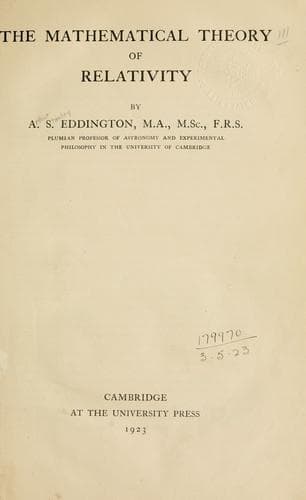
The Mathematical Theory of RelativityEddington, Arthur Stanley, Sir
Science
The Mathematical Theory of Relativity
Eddington, Arthur Stanley, Sir
Relativity (Physics)
Nos.~1 and~2 are not further considered until \SecRef{97}.
No.~3 is obtained directly from the law of gravitation in \SecRef{56}.
No.~4 is obtained from the electromagnetic equations in \SecRef{74}. These are
traced to their origin in \SecRef{96}.
No.~5 is obtained from the principle of identification in \SecRef{54}, and more
completely from the principle of measurement in \SecRef{66}. The possibility of
alternative laws is discussed in \SecRef{62}.
In the last century the ideal explanation of the phenomena of nature consisted
\index{Explanation of phenomena, ideal}%
in the construction of a mechanical model, which would act in the way
observed. Whatever may be the practical helpfulness of a model, it is no
longer recognised as contributing in any way to an ultimate explanation. A
little later, the standpoint was reached that on carrying the analysis as far as
possible we must ultimately come to a set of differential equations of which
further explanation is impossible. We can then trace the \Foreign{modus operandi}, but
as regards ultimate causes we have to confess that ``things happen so, because
the world was made in that way.'' But in the kinetic theory of gases and in
thermodynamics we have laws which can be explained much more satisfactorily.
The principal laws of gases hold, not because a gas is made ``that way,'' but
because it is made ``just anyhow.'' This is perhaps not to be taken quite
literally; but if we could see that there was the same inevitability in Maxwell's
laws and in the law of gravitation that there is in the laws of gases, we
should have reached an explanation far more complete than an ultimate arbitrary
differential equation. This suggests striving for an ideal---to show, not
that the laws of nature come from a special construction of the ultimate basis
of everything, but that the same laws of nature would prevail for the widest
possible variety of structure of that basis. The complete ideal is probably
unattainable and certainly unattained; nevertheless we shall be influenced
by it in our discussion, and it appears that considerable progress in this
direction is possible.
\PageSep{107}
\Chapter{IV}{Relativity Mechanics}
\Section{48.}{The antisymmetrical tensor of the fourth rank}
\index{Antisymmetrical tensors!of fourth rank}%
A tensor~$A_{\mu\nu}$ is said to be antisymmetrical if
\[
A_{\nu\mu} = -A_{\mu\nu}.
\]
It follows that $A_{11} = -A_{11}$, so that $A_{11}$, $A_{22}$, $A_{33}$, $A_{44}$ must all be zero.
Public-domain text, read in full here on John Shaqi.
Reviews
Reviews
No reviews yet
Be the first to share your thoughts on this work.
Elsewhere in the archive
Join the Discussion
Join the discussion
Sign in to leave a comment or review.
Sign InorCreate an account