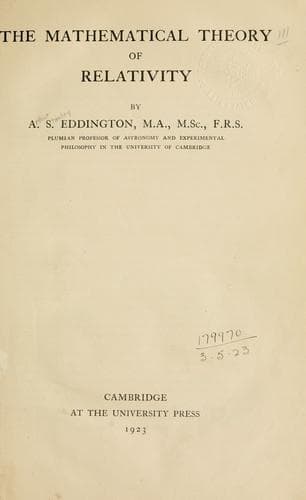
The Mathematical Theory of RelativityEddington, Arthur Stanley, Sir
Science
The Mathematical Theory of Relativity
Eddington, Arthur Stanley, Sir
Relativity (Physics)
Since the number of interchanges of the denominators is the same as the
number of interchanges of the numerators
\[
\frac{\epsilon_{\nu\xi\omicron\varpi}}{\epsilon_{\alpha\beta\gamma\delta}}
= ±1 = \frac{\epsilon_{\iota\kappa\lambda\mu}}{\epsilon_{iklm}},
\Tag{(48.43)}
\]
so that the result of the transposition is
\[
\epsilon_{\alpha\beta\gamma\delta}\, \epsilon_{\iota\kappa\lambda\mu}\,
\frac{\dd x_{\nu}'}{\dd x_{\iota}}\,
\frac{\dd x_{\xi}'}{\dd x_{\kappa}}\,
\frac{\dd x_{\omicron}'}{\dd x_{\lambda}}\,
\frac{\dd x_{\varpi}'}{\dd x_{\mu}}
= \epsilon_{\nu\xi\omicron\varpi}\, \epsilon_{iklm}\,
\frac{\dd x_{\alpha}'}{\dd x_{i}}\,
\frac{\dd x_{\beta}'}{\dd x_{k}}\,
\frac{\dd x_{\gamma}'}{\dd x_{l}}\,
\frac{\dd x_{\delta}'}{\dd x_{m}}.
\Tag{(48.5)}
\]
Making a similar transposition of the last four terms, \Eq{(48.41)}~becomes
\begin{multline*}
(4!)^{3} J^{2} g'
= g_{\alpha\epsilon}'\, g_{\beta\zeta}'\, g_{\gamma\eta}'\, g_{\delta\theta}'
· \frac{\dd x_{\alpha}'}{\dd x_{i}}\,
\frac{\dd x_{\beta}'}{\dd x_{k}}\,
\frac{\dd x_{\gamma}'}{\dd x_{l}}\,
\frac{\dd x_{\delta}'}{\dd x_{m}}
· \frac{\dd x_{\epsilon}'}{\dd x_{r}}\,
\frac{\dd x_{\zeta}'}{\dd x_{s}}\,
\frac{\dd x_{\eta}'}{\dd x_{t}}\,
\frac{\dd x_{\theta}'}{\dd x_{u}} \\
· \epsilon_{iklm}\, \epsilon_{\nu\xi\omicron\varpi}\, \epsilon_{\nu\xi\omicron\varpi}\,
\epsilon_{rstu}\, \epsilon_{\phi\chi\psi\omega}\, \epsilon_{\phi\chi\psi\omega}.
\end{multline*}
But by~\Eq{(23.22)}
\[
g_{\alpha\epsilon}'\, \frac{\dd x_{\alpha}'}{\dd x_{i}}\, \frac{\dd x_{\epsilon}'}{\dd x_{r}}
= g_{ir}.
\]
Hence
\begin{align*}
(4!)^{3} J^{2} g'
&= (4!)^{2} \epsilon_{iklm}\, \epsilon_{rstu}\, g_{ir}\, g_{ks}\, g_{lt}\, g_{mu} \\
&= (4!)^{3} g,
\end{align*}
which proves the theorem.
\PageSep{109}
Returning to $E^{\alpha\beta\gamma\delta}$, its tensor-transformation law is
\[
E'^{\mu\nu\sigma\tau} = E^{\alpha\beta\gamma\delta}\,
\frac{\dd x_{\mu}'}{\dd x_{\alpha}}\,
\frac{\dd x_{\nu}'}{\dd x_{\beta}}\,
\frac{\dd x_{\sigma}'}{\dd x_{\gamma}}\,
\frac{\dd x_{\tau}'}{\dd x_{\delta}}.
\]
Whence multiplying by~$\epsilon_{\mu\nu\sigma\tau}$ and using~\Eq{(48.1)}
\[
E' · \epsilon_{\mu\nu\sigma\tau}\, \epsilon_{\mu\nu\sigma\tau}
= E · \epsilon_{\alpha\beta\gamma\delta}\, \epsilon_{\mu\nu\sigma\tau}\,
\frac{\dd x_{\mu}'}{\dd x_{\alpha}}\,
\frac{\dd x_{\nu}'}{\dd x_{\beta}}\,
\frac{\dd x_{\sigma}'}{\dd x_{\gamma}}\,
\frac{\dd x_{\tau}'}{\dd x_{\delta}},
\]
so that by \Eq{(48.31)} and~\Eq{(48.33)}
\[
E' = JE.
\Tag{(48.6)}
\]
Thus $E$~is not an invariant for transformations of coordinates.
Public-domain text, read in full here on John Shaqi.
Reviews
Reviews
No reviews yet
Be the first to share your thoughts on this work.
Elsewhere in the archive
Join the Discussion
Join the discussion
Sign in to leave a comment or review.
Sign InorCreate an account