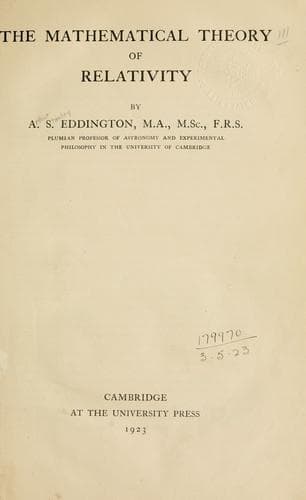
The Mathematical Theory of RelativityEddington, Arthur Stanley, Sir
Science
The Mathematical Theory of Relativity
Eddington, Arthur Stanley, Sir
Relativity (Physics)
Again
\[
E^{\alpha\beta\gamma\delta}\, E^{\epsilon\zeta\eta\theta}\,
g_{\alpha\epsilon}\, g_{\beta\zeta}\, g_{\gamma\eta}\, g_{\delta\theta}
\]
is seen by inspection to be an invariant. But this is equal to
\begin{align*}
&E^{2} \epsilon_{\alpha\beta\gamma\delta}\, \epsilon_{\mu\nu\sigma\tau}\,
g_{\alpha\epsilon}\, g_{\beta\zeta}\, g_{\gamma\eta}\, g_{\delta\theta} \\
= {} &4!\, E^{2} g.
\end{align*}
Hence
\[
\text{$E^{2} g$ is an invariant.}
\Tag{(48.65)}
\]
Accordingly
\[
E^{2} g = E'^{2} g' = (EJ)^{2} g',\quad\text{ by \Eq{(48.6)}}
\]
giving another proof that
\[
g = J^{2} g'.
\Tag{(48.7)}
\]
\emph{Corollary.} If $a$~is the determinant formed from the components~$a_{\mu\nu}$ of
\emph{any} covariant tensor, $E^{2} a$~is an invariant and
\[
a = J^{2} a'.
\Tag{(48.8)}
\]
\Section{49.}{Element of volume. Tensor-density}
In \SecRef{32} we found that the surface-element corresponding to the parallelogram
contained by two displacements, $\delta_{1} x_{\mu}$, $\delta_{2} x_{\mu}$, is the antisymmetrical tensor
\[
dS^{\mu\nu} = \left|\begin{array}{@{}cc@{}}
\delta_{1} x_{\mu} & \delta_{1} x_{\nu} \\
\delta_{2} x_{\mu} & \delta_{2} x_{\nu} \\
\end{array}\right|.
\]
Similarly we define the volume-element (four-dimensional) corresponding to
\index{Volume-element}%
the hyperparallelopiped contained by four displacements, $\delta_{1} x_{\mu}$, $\delta_{2} x_{\mu}$, $\delta_{3} x_{\mu}$, $\delta_{4} x_{\mu}$,
as the tensor
\[
dV^{\mu\nu\sigma\tau} = \left|\begin{array}{@{}cccc@{}}
\delta_{1} x_{\mu} & \delta_{1} x_{\nu} & \delta_{1} x_{\sigma} & \delta_{1} x_{\tau} \\
\delta_{2} x_{\mu} & \delta_{2} x_{\nu} & \delta_{2} x_{\sigma} & \delta_{2} x_{\tau} \\
\delta_{3} x_{\mu} & \delta_{3} x_{\nu} & \delta_{3} x_{\sigma} & \delta_{3} x_{\tau} \\
\delta_{4} x_{\mu} & \delta_{4} x_{\nu} & \delta_{4} x_{\sigma} & \delta_{4} x_{\tau} \\
\end{array}\right|.
\Tag{(49.1)}
\]
It will be seen that the determinant is an antisymmetrical tensor of the fourth
rank, and its $256$~components accordingly have one or other of the three values
\[
+dV,\quad 0,\quad -dV,
\]
where $dV = ±dV^{1234}$. It follows from \Eq{(48.65)} that $(dV)^{2} g$~is an invariant, so
that
\[
\text{$\sqrt{-g} · dV$ is an invariant.}
\Tag{(49.2)}
\]
%\PageSep{110}
Since the sign of $dV^{1234}$ is associated with some particular cycle of
enumeration of the edges of the parallelopiped, which is not usually of any
importance, the single positive quantity~$dV$ is usually taken to represent the
volume-element fully. Summing a number of infinitesimal volume-elements,
\index{Volume!physical and geometrical}%
we have
\[
\iiiint \sqrt{-g} · dV\quad\text{is an invariant,}
\Tag{(49.3)}
\]
the integral being taken over any region defined independently of the
coordinates.
Public-domain text, read in full here on John Shaqi.
Reviews
Reviews
No reviews yet
Be the first to share your thoughts on this work.
Elsewhere in the archive
Join the Discussion
Join the discussion
Sign in to leave a comment or review.
Sign InorCreate an account