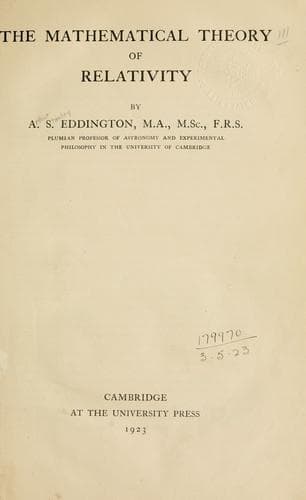
The Mathematical Theory of RelativityEddington, Arthur Stanley, Sir
Science
The Mathematical Theory of Relativity
Eddington, Arthur Stanley, Sir
Relativity (Physics)
A nearly similar result is obtained for tensors. The integral
\[
\int T^{\mu\nu} \sqrt{-g}\, d\tau
\]
over an absolutely defined region is not a tensor; because, although it is the
sum of a number of tensors, these tensors are not located at the same point
and cannot be combined (\SecRef{33}). But in the limit as the region is made
infinitely small its transformation law approaches more and more nearly that
of a single tensor. Thus $T^{\mu\nu} \sqrt{-g}$~is a \emph{tensor-density}, representing the amount
\index{Tensor-density}%
per unit mesh of a tensor in the infinitesimal region round the point.
It is usual to represent the tensor-density corresponding to any tensor by
\index{German letters, denoting tensor-densities}%
the corresponding German letter; thus
\[
\mf{T}^{\mu\nu} \equiv T^{\mu\nu} \sqrt{-g};\quad
\mf{T} \equiv T \sqrt{-g}.
\Tag{(49.5)}
\]
By \Eq{(48.1)}
\[
\mf{E}^{\alpha\beta\gamma\delta} \equiv E^{\alpha\beta\gamma\delta} \sqrt{-g}
= E \sqrt{-g} · \epsilon_{\alpha\beta\gamma\delta},
\]
and since $E \sqrt{-g}$ is an invariant it follows that $\epsilon_{\alpha\beta\gamma\delta}$~is a tensor-density.
Physical quantities are of two main kinds, e.g.\
\index{Intensity and quantity}%
\index{Quantity and intensity}%
\begin{alignat*}{2}
&\text{Field of acceleration}
&&= \text{\emph{intensity} of some condition at a point,} \\
&\text{Momentum}
&&= \text{\emph{quantity} of something in a volume.}
\end{alignat*}
The latter kind are naturally expressed as ``so much per unit mesh.'' Hence
\emph{intensity} is naturally described by a tensor, and \emph{quantity} by a tensor-density.
We shall find $\sqrt{-g}$~continually appearing in our formulae; that is an indication
that the physical quantities concerned are strictly tensor-densities rather
than tensors. In the general theory tensor-densities are at least as important
as tensors.
We can only speak of the amount of momentum in a large volume when
a definite system of coordinates has been fixed. The total momentum is the
sum of the momenta in different elements of volume; and for each element
there will be different coefficients of transformation, when a change of coordinates
is made. The only case in which we can state the amount of something
in a large region without fixing a special system of coordinates is when we
are dealing with an invariant; e.g.\ the amount of ``Action'' in a large region
is independent of the coordinates. In short, tensor-analysis (except in the
degenerate case of invariants) deals with things located at a point and not
spread over a large region; that is why we usually have to use densities
instead of quantities.
Public-domain text, read in full here on John Shaqi.
Reviews
Reviews
No reviews yet
Be the first to share your thoughts on this work.
Elsewhere in the archive
Join the Discussion
Join the discussion
Sign in to leave a comment or review.
Sign InorCreate an account