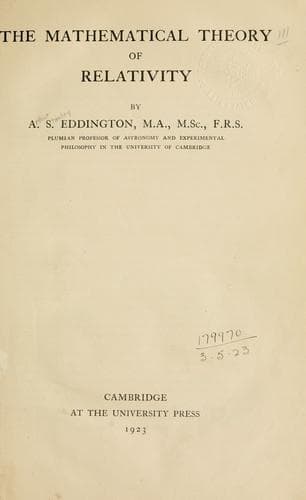
The Mathematical Theory of RelativityEddington, Arthur Stanley, Sir
Science
The Mathematical Theory of Relativity
Eddington, Arthur Stanley, Sir
Relativity (Physics)
When the quadruple integral is regarded as the limit of a sum, the infinitesimal
parallelopipeds may be taken of any shape and orientation; but for
analytical integration we choose them to be coincident with meshes of the
coordinate-system that is being used, viz.\
\[
\delta_{1} x_{\mu} = (dx_{1}, 0, 0, 0);\
\delta_{2} x_{\mu} = (0, dx_{2} , 0, 0);\quad\text{etc.}
\]
Then \Eq{(49.1)}~reduces to a single diagonal
\[
dV = dx_{1}\, dx_{2}\, dx_{3}\, dx_{4}.
\]
We write $d\tau$ for the volume-element when chosen in this way, so that
\[
d\tau = dx_{1}\, dx_{2}\, dx_{3}\, dx_{4}.
\]
It is not usually necessary to discriminate between~$d\tau$ and the more
general expression~$dV$; and we shall usually regard $\sqrt{-g} · d\tau$ as an invariant.
Strictly speaking we mean that $\sqrt{-g} · d\tau$ behaves as an invariant in volume-integration;
whereas $\sqrt{-g} · dV$ is intrinsically invariant.
For Galilean coordinates $x$, $y$, $z$, $t$, we have $\sqrt{-g} = 1$, so that
\[
\sqrt{-g}\, d\tau = dx\, dy\, dz\, dt.
\Tag{(49.41)}
\]
Further if we take an observer at rest in this Galilean system, $dx\, dy\,dz$~is his
element of proper-volume (three-dimensional)~$dW$, and $dt$~is his proper-time~$ds$.
\index{Proper-volume}%
Hence
\[
\sqrt{-g}\, d\tau = dW\, ds.
\Tag{(49.42)}
\]
By \Eq{(49.41)} we see that $\sqrt{-g}\, d\tau$ is the volume in natural measure of the
four-dimensional element. This natural or invariant volume is a physical
conception---the result of physical measures made with unconstrained scales;
it may be contrasted with the geometrical volume~$dV$ or~$d\tau$, which expresses
the number of unit meshes contained in the region.
Let $T$~be a scalar, i.e.\ an invariant function of position; then, since
$T\sqrt{-g}\, dV$~is an invariant,
\[
\int T\sqrt{-g}\, d\tau\quad\text{is an invariant}
\]
for any absolutely defined four-dimensional region. Each unit mesh (whose
edges $dx_{1}$, $dx_{2}$, $dx_{3}$, $dx_{4}$ are unity) contributes the amount $T\sqrt{-g}$ to this
\PageSep{111}
invariant. Accordingly we call $T\sqrt{-g}$ the \emph{scalar-density}\footnote
{I have usually avoided the superfluous word ``scalar,'' which is less expressive than its
synonym ``invariant.'' But it is convenient here in order to avoid confusion between the density
\emph{of an invariant} and a density \emph{which is invariant}. The latter,~$\rho_{0}$, has hitherto been called the
invariant density (without the hyphen).}
or \emph{invariant-density}.
\index{Density!scalar-and tensor-}%
\index{Scalar-density}%
\index{Invariant-density (scalar-density)}%
Public-domain text, read in full here on John Shaqi.
Reviews
Reviews
No reviews yet
Be the first to share your thoughts on this work.
Elsewhere in the archive
Join the Discussion
Join the discussion
Sign in to leave a comment or review.
Sign InorCreate an account