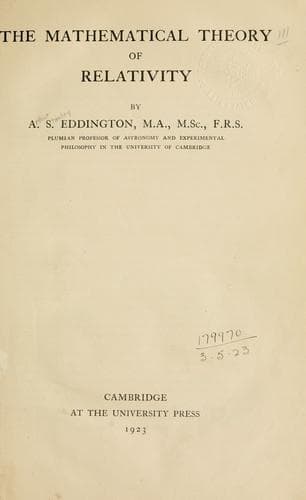
The Mathematical Theory of RelativityEddington, Arthur Stanley, Sir
Science
The Mathematical Theory of Relativity
Eddington, Arthur Stanley, Sir
Relativity (Physics)
In three dimensions the vanishing of the divergence is the condition of
continuity of flux, e.g.\ in hydrodynamics $\dd u/\dd x + \dd v/\dd y + \dd w/\dd z = 0$. Adding a
time-coordinate, this becomes the condition of \emph{conservation} or \emph{permanence}, as
\index{Permanence}%
will be shown in detail later. \emph{It will be realised how important for a theory
of the material world is the discovery of a world-tensor which is inherently
permanent.}
I think it should be possible to prove~\Eq{(52)} by geometrical reasoning in
continuation of the ideas of \SecRef{33}. But I have not been able to construct a
geometrical proof and must content myself with a clumsy analytical verification.
By the rules of covariant differentiation
\[
(g_{\mu}^{\nu} G)_{\nu}
= g_{\mu}^{\nu}\, \Chg{\dd G/\dd x_{\nu}}{\frac{\dd G}{\dd x_{\nu}}}
= \Chg{\dd G/\dd x_{\mu}}{\frac{\dd G}{\dd x_{\mu}}}.
\]
Thus the theorem reduces to
\[
G_{\mu\nu}^{\nu} = \frac{1}{2}\, \frac{\dd G}{\dd x_{\mu}}.
\Tag{(52.1)}
\]
For $\mu = 1$, $2$, $3$, $4$, these are the four identities referred to in \SecRef{37}. By~\Eq{(51.32)}
\[
G_{\mu\nu}^{\nu}
= \frac{1}{\sqrt{-g}}\, \frac{\dd}{\dd x_{\nu}} (G_{\mu}^{\nu} \sqrt{-g})
+ \tfrac{1}{2} G_{\alpha\beta}\, \frac{\dd g^{\alpha\beta}}{\dd x_{\mu}},
\]
and since $G = g^{\alpha\beta} G_{\alpha\beta}$
\[
\frac{1}{2}\, \frac{\dd G}{\dd x_{\mu}}
= \tfrac{1}{2} g^{\alpha\beta}\, \frac{\dd G_{\alpha\beta}}{\dd x_{\mu}}
+ \tfrac{1}{2} G_{\alpha\beta}\, \frac{\dd g^{\alpha\beta}}{\dd x_{\mu}}.
\]
Hence, subtracting, we have to prove that
\[
\frac{1}{\sqrt{-g}}\, \frac{\dd}{\dd x_{\nu}} (G_{\mu}^{\nu} \sqrt{-g})
= \tfrac{1}{2} g^{\alpha\beta}\, \frac{\dd G_{\alpha\beta}}{\dd x_{\mu}}.
\Tag{(52.2)}
\]
Since \Eq{(52)}~is a tensor relation it is sufficient to show that it holds for a special
coordinate-system; only we must be careful that our special choice of coordinate-system
does not limit the kind of space-time and so spoil the generality
of the proof. It has been shown in \SecRef{36} that in any kind of space-time, coordinates
can be chosen so that all the first derivatives~$\dd g_{\mu\nu}/\dd x_{\sigma}$ vanish at a
particular point; we shall therefore lighten the algebra by taking coordinates
such that at the point considered
\[
\frac{\dd g_{\mu\nu}}{\dd x_{\sigma}} = 0.
\Tag{(52.3)}
\]
\PageSep{116}
This condition can, of course, only be applied after all differentiations have
been performed. Then
\[
\frac{1}{\sqrt{-g}}\, \frac{\dd}{\dd x_{\nu}} (G_{\mu}^{\nu} \sqrt{-g})
= \frac{1}{\sqrt{-g}}\, \frac{\dd}{\dd x_{\nu}} (g^{\nu\tau} g^{\sigma\rho} \sqrt{-g}· B_{\mu\tau\sigma\rho}).
\]
Owing to~\Eq{(52.3)} $g^{\nu\tau} g^{\sigma\rho} \sqrt{-g}$ can be taken outside the differential operator,
giving
\[
g^{\nu\tau} g^{\sigma\rho}\, \frac{\dd}{\dd x_{\nu}} B_{\mu\tau\sigma\rho},
\]
which by~\Eq{(34.5)} is equal to
\[
\tfrac{1}{2} g^{\nu\tau} g^{\sigma\rho} \left(
\frac{\dd^{2} g_{\rho\sigma}}{\dd x_{\mu}\, \dd x_{\tau}}
Public-domain text, read in full here on John Shaqi.
Reviews
Reviews
No reviews yet
Be the first to share your thoughts on this work.
Elsewhere in the archive
Join the Discussion
Join the discussion
Sign in to leave a comment or review.
Sign InorCreate an account