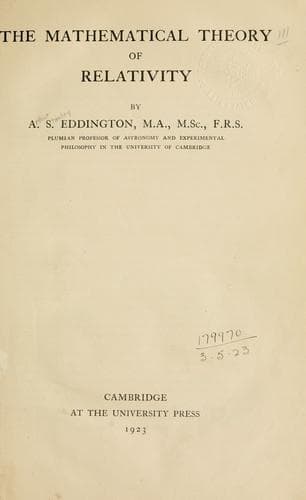
The Mathematical Theory of RelativityEddington, Arthur Stanley, Sir
Science
The Mathematical Theory of Relativity
Eddington, Arthur Stanley, Sir
Relativity (Physics)
+ \frac{\dd^{2} g_{\mu\tau}}{\dd x_{\rho}\, \dd x_{\sigma}}
- \frac{\dd^{2} g_{\mu\sigma}}{\dd x_{\rho}\, \dd x_{\tau}}
- \frac{\dd^{2} g_{\rho\tau}}{\dd x_{\mu}\, \dd x_{\sigma}}\right).
\Tag{(52.4)}
\]
The rest of~$B_{\mu\tau\sigma\rho}$ is omitted because it consists of products of two vanishing
factors ($3$-index symbols), so that after differentiation by~$\dd x_{\nu}$ one vanishing
factor always remains.
By the double interchange $\sigma$ for~$\tau$, $\rho$~for $\nu$, two terms in~\Eq{(52.4)} cancel out,
leaving
\[
\frac{1}{\sqrt{-g}}\, \frac{\dd}{\dd x_{\nu}} (G_{\mu}^{\nu} \sqrt{-g})
= \tfrac{1}{2} g^{\nu\tau} g^{\sigma\rho}\, \frac{\dd}{\dd x_{\nu}} \left(
\frac{\dd^{2} g_{\rho\sigma}}{\dd x_{\mu}\, \dd x_{\tau}}
- \frac{\dd^{2} g_{\rho\tau}}{\dd x_{\mu}\, \dd x_{\sigma}}\right).
\Tag{(52.51)}
\]
Similarly
\begin{align*}
\tfrac{1}{2} g^{\alpha\beta}\, \frac{\dd G_{\alpha\beta}}{\dd x_{\mu}}
&= \tfrac{1}{2} g^{\nu\tau}\, \frac{\dd G_{\nu\tau}}{\dd x_{\mu}}
= \tfrac{1}{2} g^{\nu\tau}\, \frac{\dd}{\dd x_{\mu}} (g^{\sigma\rho} B_{\nu\tau\sigma\rho}) \\
&= \tfrac{1}{4} g^{\nu\tau} g^{\sigma\rho}\, \frac{\dd}{\dd x_{\mu}}
\left(\frac{\dd^{2} g_{\rho\sigma}}{\dd x_{\nu}\, \dd x_{\tau}}
+ \frac{\dd^{2} g_{\nu\tau}}{\dd x_{\rho}\, \dd x_{\sigma}}
- \frac{\dd^{2} g_{\nu\sigma}}{\dd x_{\rho}\, \dd x_{\tau}}
- \frac{\dd^{2} g_{\rho\tau}}{\dd x_{\nu}\, \dd x_{\sigma}}\right) \\
&= \tfrac{1}{2} g^{\nu\tau} g^{\sigma\rho}\, \frac{\dd}{\dd x_{\mu}} \left(
\frac{\dd^{2} g_{\rho\sigma}}{\dd x_{\nu}\, \dd x_{\tau}}
- \frac{\dd^{2} g_{\rho\tau}}{\dd x_{\nu}\, \dd x_{\sigma}}\right),
\Tag{(52.52)}
\end{align*}
since the double interchange $\sigma$ for~$\tau$, $\rho$~for $\nu$, causes two terms to become
equal to the other two.
Comparing \Eq{(52.51)} and \Eq{(52.52)} we see that the required result is established
for coordinates chosen so as to have the property~\Eq{(52.3)} at the point
considered; and since it is a tensor equation it must hold true for all systems
of coordinates.
\Section{53.}{The material energy-tensor}
\index{Energy-tensor of matter}%
\index{T@$T_{\mu\nu}$ (energy-tensor)}%
Let $\rho_{0}$~be the proper-density of matter, and let $dx_{\mu}/ds$ refer to the motion
of the matter; we write, as in~\Eq{(46.8)},
\[
T^{\mu\nu} = \rho_{0}\, \frac{dx_{\mu}}{ds}\, \frac{dx_{\nu}}{ds}.
\Tag{(53.1)}
\]
Then $T^{\mu\nu}$ (with the associated mixed and covariant tensors) is called the
\emph{energy-tensor} of the matter.
\PageSep{117}
For matter moving with any velocity relative to Galilean coordinates, the
coordinate-density~$\rho$ is given by
\[
\rho = \rho_{0} \left(\frac{dt}{ds}\right)^{2},
\Tag{(53.2)}
\]
for, as explained in~\Eq{(14.2)}, the FitzGerald factor $\beta = dt/ds$ appears twice, once
for the increase of mass with velocity and once for the contraction of volume.
Public-domain text, read in full here on John Shaqi.
Reviews
Reviews
No reviews yet
Be the first to share your thoughts on this work.
Elsewhere in the archive
Join the Discussion
Join the discussion
Sign in to leave a comment or review.
Sign InorCreate an account