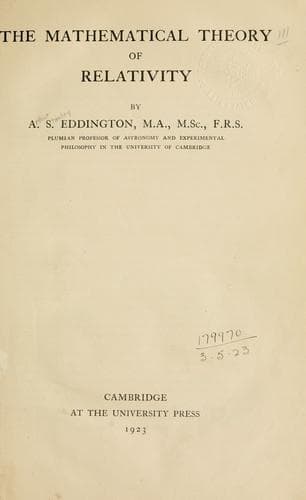
The Mathematical Theory of RelativityEddington, Arthur Stanley, Sir
Science
The Mathematical Theory of Relativity
Eddington, Arthur Stanley, Sir
Relativity (Physics)
For $\mu = 1$, we have
\begin{align*}
\frac{\dd p_{xx}}{\dd x} + \frac{\dd p_{xy}}{\dd y} + \frac{\dd p_{xz}}{\dd z}
&= -\left(\frac{\dd(\rho u^{2})}{\dd x} + \frac{\dd(\rho uv)}{\dd y}
+ \frac{\dd(\rho uw)}{\dd z} + \frac{\dd(\rho u)}{\dd t}\right) \\
&= -u \left(\frac{\dd(\rho u)}{\dd x} + \frac{\dd(\rho v)}{\dd y}
+ \frac{\dd(\rho w)}{\dd z} + \frac{\dd\rho}{\dd t}\right) \\
&\quad -\rho \left(u\, \frac{\dd u}{\dd x} + v\, \frac{\dd u}{\dd y}
+ w\, \frac{\dd u}{\dd z} + \frac{\dd u}{\dd t}\right) \\
&= -\rho\, \frac{Du}{Dt}
\Tag{(53.72)}
\end{align*}
by~\Eq{(53.71)}. $Du/Dt$~is the acceleration of the element of the fluid.
This is the well-known equation of hydrodynamics when no body-force is
\index{Hydrodynamics, equations of}%
acting. (By adopting Galilean coordinates any field of force acting on the
mass of the fluid has been removed.)
Equations \Eq{(53.71)} and \Eq{(53.72)} express directly the conservation of mass
and momentum, so that for Galilean coordinates these principles are contained
\index{Momentum!conservation of}%
in
\[
\dd T^{\mu\nu}/\dd x_{\nu} = 0.
\]
In fact $\dd T^{\mu\nu}/\dd x_{\nu}$ represents the rate of creation of momentum and mass in
unit volume. In classical hydrodynamics momentum may be created in the
volume (i.e.\ may appear in the volume without having crossed the boundary)
by the action of a body-force $\rho X$, $\rho Y$, $\rho Z$; and these terms are added on the
right-hand side of~\Eq{(53.72)}. The creation of mass is considered impossible.
Accordingly the more general equations of \emph{classical hydrodynamics} are
\[
\frac{\dd T^{\mu\nu}}{\dd x_{\nu}} = (\rho X, \rho Y, \rho Z, 0).
\Tag{(53.81)}
\]
In the \emph{special relativity theory} mass is equivalent to energy, and the body-forces
by doing work on the particles will also create mass, so that
\[
\frac{\dd T^{\mu\nu}}{\dd x_{\nu}} = (\rho X, \rho Y, \rho Z, \rho S),
\Tag{(53.82)}
\]
where $\rho S$~is the work done by the forces $\rho X$, $\rho Y$, $\rho Z$. These older formulae
are likely to be only approximate; and the exact formulae must be deduced
by extending the general relativity theory to the case when fields of force are
present, viz.\ to non-Galilean coordinates.
Public-domain text, read in full here on John Shaqi.
Reviews
Reviews
No reviews yet
Be the first to share your thoughts on this work.
Elsewhere in the archive
Join the Discussion
Join the discussion
Sign in to leave a comment or review.
Sign InorCreate an account