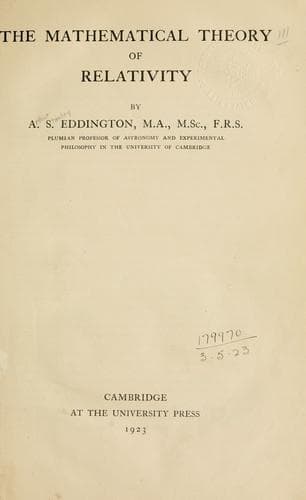
The Mathematical Theory of RelativityEddington, Arthur Stanley, Sir
Science
The Mathematical Theory of Relativity
Eddington, Arthur Stanley, Sir
Relativity (Physics)
It is often convenient to use the mixed tensor~$T_{\mu}^{\nu}$ in place of~$T^{\mu\nu}$. For
Galilean coordinates we obtain from~\Eq{(53.5)}\footnote
{E.g.\ $T_{2}^{1} = \rho_{\sigma 2} T^{\sigma 1} = 0 - T^{21} + 0 + 0$.}
\[
\begin{array}[t]{r}
T_{\mu}^{\nu} \\
\MuNuarrow
\end{array}
=
\begin{array}[t]{@{}c@{,\quad}c@{,\quad}c@{,\quad}c@{}}
-p_{xx} - \rho u^{2} & -p_{yx} - \rho vu & -p_{zx} - \rho wu & \rho u\Add{,} \\
-p_{xy} - \rho uv & -p_{yy} - \rho v^{2} & -p_{yz} - \rho wv & \rho v\Add{,} \\
-p_{xz} - \rho uw & -p_{yz} - \rho vw & -p_{zz} - \rho w^{2} & \rho w\Add{,} \\
-\rho u & -\rho v & -\rho w & \rho\Add{.} \\
\end{array}
\Tag{(53.91)}
\]
\PageSep{119}
The equation equivalent to~\Eq{(53.82)} is then
\[
\frac{\dd T_{\mu}^{\nu}}{\dd x_{\nu}} = (-\rho X,-\rho Y,-\rho Z, \rho S).
\Tag{(53.92)}
\]
That is to say $\dd T_{\mu}^{\nu}/\dd x_{\nu}$ is the rate of creation of negative momentum and of
positive mass or energy in unit volume.
\Section{54.}{New derivation of Einstein's law of gravitation}
\index{Continuous matter, gravitation in}%
\index{Einstein's law of gravitation!in continuous matter}%
We have found that for Galilean coordinates
\[
\Chg{\dd T^{\mu\nu}/\dd x_{\nu}}{\frac{\dd T^{\mu\nu}}{\dd x_{\nu}}} = 0.
\Tag{(54.1)}
\]
This is evidently a particular case of the tensor equation
\[
(T^{\mu\nu})_{\nu} = 0.
\Tag{(54.21)}
\]
Or we may use the equivalent equation
\[
(T_{\mu}^{\nu})_{\nu} = 0,
\Tag{(54.22)}
\]
which results from lowering the suffix~$\mu$. In other words the divergence of
\index{Divergence!energy@of energy-tensor}%
the energy-tensor vanishes.
Taking the view that energy, stress, and momentum belong to the world
(space-time) and not to some extraneous substance in the world, we must
identify the energy-tensor with some fundamental tensor, i.e.\ a tensor belonging
to the fundamental series derived from~$g_{\mu\nu}$.
The fact that the divergence of~$T_{\mu}^{\nu}$ vanishes points to an identification
with $(G_{\mu}^{\nu} - \frac{1}{2}g_{\mu}^{\nu} G)$ whose divergence vanishes \emph{identically} (\SecRef{52}). Accordingly
we set
\[
G_{\mu}^{\nu} - \tfrac{1}{2}g_{\mu}^{\nu} G - 8\pi T_{\mu}^{\nu},
\Tag{(54.3)}
\]
the factor~$8\pi$ being introduced for later convenience in coordinating the units.
To pass from \Eq{(54.1)} to \Eq{(54.21)} involves an appeal to the hypothetical
Principle of Equivalence; but by taking \Eq{(54.3)} as our fundamental equation
\index{Identification, Principle of}%
\index{Principle!of identification}%
of gravitation \Eq{(54.21)}~becomes an identity requiring no hypothetical assumption.
Public-domain text, read in full here on John Shaqi.
Reviews
Reviews
No reviews yet
Be the first to share your thoughts on this work.
Elsewhere in the archive
Join the Discussion
Join the discussion
Sign in to leave a comment or review.
Sign InorCreate an account