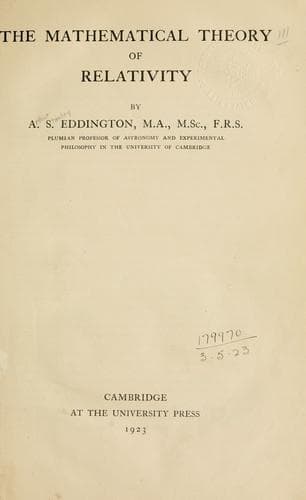
The Mathematical Theory of RelativityEddington, Arthur Stanley, Sir
Science
The Mathematical Theory of Relativity
Eddington, Arthur Stanley, Sir
Relativity (Physics)
The alternative formula~\Eq{(51.51)} may be used to calculate~$T_{\mu\nu}^{\nu}$, giving
\[
\frac{\dd}{\dd x_{\nu}} \mf{T}_{\mu}^{\nu}
= \tfrac{1}{2} \mf{T}^{\alpha\beta}\, \frac{\dd g_{\alpha\beta}}{\dd x_{\mu}}.
\Tag{(55.6)}
\]
Retaining on the right only~$\mf{T}^{44}$, we have by comparison with~\Eq{(55.51)}
\[
X,\ Y,\ Z = -\frac{1}{2}\, \frac{\dd g_{44}}{\dd x},\
-\frac{1}{2}\, \frac{\dd g_{44}}{\dd y},\
-\frac{1}{2}\, \frac{\dd g_{44}}{\dd z}.
\Tag{(55.7)}
\]
\PageSep{124}
Hence, for a static coordinate-system
\begin{align*}
X\, dx + Y\, dy + Z\, dz
&= -\frac{1}{2}\left(\frac{\dd g_{44}}{\dd x}\, dx + \frac{\dd g_{44}}{\dd y}\, dy + \frac{\dd g_{44}}{\dd z}\, dz\right) \\
&= -\tfrac{1}{2} dg_{44},
\end{align*}
so that $X$, $Y$, $Z$ are derivable from a potential
\index{Potential!gravitational}%
\[
\Omega = -\tfrac{1}{2} g_{44} + \text{const.}
\]
Choosing the constant so that $g_{44} = 1$ when $\Omega = 0$
\[
g_{44} = 1 - 2\Omega.
\Tag{(55.8)}
\]
Special cases of this result will be found in~\Eq{(15.4)} and~\Eq{(38.8)}, $\Omega$~being the
potential of the centrifugal force and of the Newtonian gravitational force
respectively.
Let us now briefly review the principal steps in our new derivation of the
laws of mechanics and gravitation. We concentrate attention on the world-tensor~$T_{\mu}^{\nu}$
\emph{defined} by
\[
T_{\mu}^{\nu} = -\frac{1}{8\pi} (G_{\mu}^{\nu} - \tfrac{1}{2} g_{\mu}^{\nu} G).
\]
The question arises how this tensor would be recognised in nature---what
names has the practical observer given to its components? We suppose
tentatively that when Galilean or natural coordinates are used $T_{4}^{4}$~is recognised
as the amount of mass or energy per unit volume, $T_{1}^{4}$, $T_{2}^{4}$, $T_{3}^{4}$ as the negative
momentum per unit volume, and the remaining components contain the
stresses according to the detailed specifications in~\Eq{(53.91)}. This can only be
tested by examining whether the components of~$T_{\mu}^{\nu}$ do actually obey the laws
which mass, momentum and stress are known by observation to obey. For
natural coordinates the empirical laws are expressed by $\dd T_{\mu}^{\nu}/\dd x_{\nu} = 0$, which is
satisfied because our tensor from its definition has been proved to satisfy
$(T_{\mu}^{\nu})_{\nu} = 0$ identically. When the coordinates are not natural, the identity
$T_{\mu\nu}^{\nu} = 0$ gives the more general law
\[
\frac{\dd}{\dd x_{\nu}} \mf{T}_{\mu}^{\nu}
= \frac{1}{2}\, \frac{\dd g_{\alpha\beta}}{\dd x_{\mu}}\, \mf{T}^{\alpha\beta}.
\]
We attribute an abstract Galilean geometry to these coordinates, and
should accordingly identify the components of~$T_{\mu}^{\nu}$ as before, just as though
the coordinates were natural; but owing to the resulting confusion of unit
mesh with unit natural volume, the tensor-densities $\mf{T}_{1}^{4}$, $\mf{T}_{2}^{4}$, $\mf{T}_{3}^{4}$, $\mf{T}_{4}^{4}$ will now
be taken to represent the negative momentum and energy per unit volume.
Public-domain text, read in full here on John Shaqi.
Reviews
Reviews
No reviews yet
Be the first to share your thoughts on this work.
Elsewhere in the archive
Join the Discussion
Join the discussion
Sign in to leave a comment or review.
Sign InorCreate an account