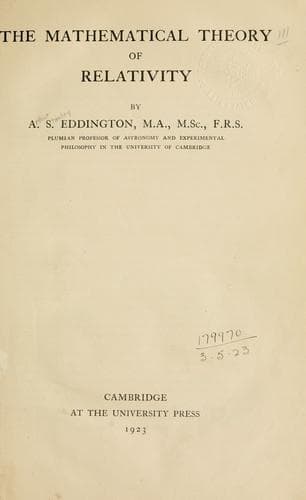
The Mathematical Theory of RelativityEddington, Arthur Stanley, Sir
Science
The Mathematical Theory of Relativity
Eddington, Arthur Stanley, Sir
Relativity (Physics)
In accordance with the definition of force as rate of change of momentum,
the quantity on the right will be recognised as the (negative) body-force
acting on unit volume, the three components of the force being given by
$\mu = 1$, $2$,~$3$. When the velocity of the matter is very small compared with the
velocity of light as in most ordinary problems, we need only consider on the
\PageSep{125}
right the component~$\mf{T}^{44}$ or~$\rho$; and the force is then due to a field of acceleration
of the usual type with components $-\frac{1}{2}\dd g_{44}/\dd x_{1}$, $-\frac{1}{2}\dd g_{44}/\dd x_{2}$, $-\frac{1}{2}\dd g_{44}/\dd x_{3}$.
The potential~$\Omega$ of the field of acceleration is thus connected with~$g_{44}$ by the
relation $g_{44} = 1 - 2\Omega$. When this approximation is not sufficient there is no
simple field of acceleration; the acceleration of the matter depends not only
on its position but also on its velocity and even on its state of stress.
Einstein's law of gravitation for empty space $G_{\mu\nu} = 0$ follows at once from the
above identification of~$T_{\mu}^{\nu}$.
\Section{56.}{Dynamics of a particle}
\index{Dynamics of a particle}%
\index{Particle!dynamics of}%
\index{Particle!symmetry of}%
An isolated particle is a narrow tube in four dimensions containing a non-zero
energy-tensor and surrounded by a region where the energy-tensor is
zero. The tube is the world-line or track of the particle in space-time.
\index{World-line}%
The momentum and mass of the particle are obtained by integrating~$\mf{T}_{\mu}^{4}$
over a three-dimensional volume; if the result is written in the form
\[
-Mu,\ -Mv,\ -Mw,\ M,
\]
then $M$~is the mass (relative to the coordinate system), and $(u, v, w)$ is the
\emph{dynamical velocity} of the particle, i.e.\ the ratio of the momenta to the mass.
\index{Dynamical velocity}%
The \emph{kinematical velocity} of the particle is given by the direction of the
\index{Kinematical velocity}%
tube in four dimensions, viz.\ $\left(\dfrac{dx_{1}}{dx_{4}}, \dfrac{dx_{2}}{dx_{4}}, \dfrac{dx_{3}}{dx_{4}}\right)$ along the tube. For completely
continuous matter there is no division of the energy-tensor into tubes and the
notion of kinematical velocity does not arise.
It does not seem to be possible to deduce without special assumptions that
the dynamical velocity of a particle is equal to the kinematical velocity. The
law of conservation merely shows that $(Mu, Mv, Mw, M)$ is constant along the
tube when no field of force is acting; it does not show that the direction of
this vector is the direction of the tube.
Public-domain text, read in full here on John Shaqi.
Reviews
Reviews
No reviews yet
Be the first to share your thoughts on this work.
Elsewhere in the archive
Join the Discussion
Join the discussion
Sign in to leave a comment or review.
Sign InorCreate an account