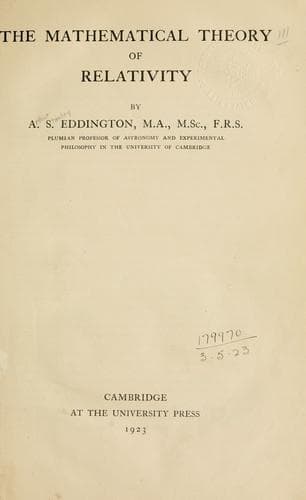
The Mathematical Theory of RelativityEddington, Arthur Stanley, Sir
Science
The Mathematical Theory of Relativity
Eddington, Arthur Stanley, Sir
Relativity (Physics)
Suppose that in this volume there is only a single particle, so that the
energy-tensor vanishes everywhere except in a narrow tube. By~\Eq{(56.1)} the
quadruple integral becomes
\[
-\iiiint \{\alpha\nu, \mu\} \frac{dx_{\alpha}}{ds}\, \frac{dx_{\nu}}{ds}\, \rho_{0} \sqrt{-g}\, d\tau
= -\{\alpha\beta, \mu\} \frac{dx_{\alpha}}{ds}\, \frac{dx_{\beta}}{ds}\, m\, ds,
\Tag{(56.4)}
\]
since $\rho_{0} \sqrt{-g}\, d\tau = \rho_{0}\, dW · ds = dm · ds$, where $dm$~is the proper-mass.
On the left the triple integrals vanish except at the two points where the
world-line intersects the boundary of the region. For convenience we draw
the boundary near these two points in the planes $dx_{1} = 0$, so that only the first
of the four integrals survives. The left-hand side of~\Eq{(56.3)} becomes
\[
\left[\iiint \rho_{0} \sqrt{-g}\, \frac{dx_{\mu}}{ds}\, \frac{dx_{1}}{ds}\, dx_{2}\, dx_{3}\, dx_{4}\right],
\Tag{(56.51)}
\]
the bracket denoting the difference at the two ends of the world-line.
The geometrical volume of the oblique cylinder cut off from the tube by
sections $dx_{2}\, dx_{3}\, dx_{4}$ at a distance apart~$ds$ measured along the tube is
\[
\frac{dx_{1}}{ds} · ds\, dx_{2}\, dx_{3}\, dx_{4}.
\]
%\PageSep{127}
Multiplying by $\rho_{0} \sqrt{-g}$ we get the amount of~$\rho_{0}$ contained\footnotemark,\footnotetext
{The amount of density in a four-dimensional volume is, of course, not the mass but a
quantity of dimensions $\text{mass} \times \text{time}$.}
which is~$dm\, ds$.
Hence \Eq{(56.51)}~reduces to
\[
\left[m\, \frac{dx_{\mu}}{ds}\right].
\]
The difference at the two limits is
\[
\frac{d}{ds} \left(m\, \frac{dx_{\mu}}{ds}\right) ds,
\Tag{(56.52)}
\]
where $ds$~is now the length of track between the two limits as in~\Eq{(56.4)}.
By \Eq{(56.4)} and~\Eq{(56.52)} the equation reduces to
\[
\frac{d}{ds} \left(m\, \frac{dx_{\mu}}{ds}\right)
= -m \{\alpha\beta, \mu\}\, \frac{dx_{\alpha}}{ds}\, \frac{dx_{\beta}}{ds}.
\Tag{(56.6)}
\]
Provided that $m$~is constant this gives the equations of a geodesic \Eq{(28.5)},
showing that the track of an isolated particle is a geodesic. The constancy of~$m$
can be proved formally as follows---
Public-domain text, read in full here on John Shaqi.
Reviews
Reviews
No reviews yet
Be the first to share your thoughts on this work.
Elsewhere in the archive
Join the Discussion
Join the discussion
Sign in to leave a comment or review.
Sign InorCreate an account