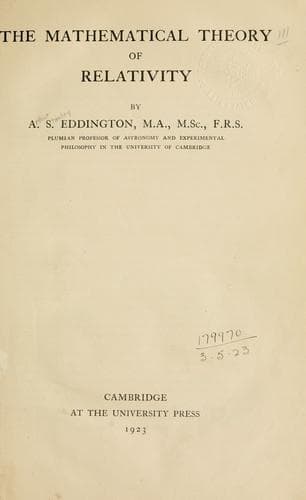
The Mathematical Theory of RelativityEddington, Arthur Stanley, Sir
Science
The Mathematical Theory of Relativity
Eddington, Arthur Stanley, Sir
Relativity (Physics)
I think there is no doubt that in nature the dynamical and kinematical
velocities are the same; but the reason for this must be sought in the symmetrical
properties of the ultimate particles of matter. If we assume as in
\SecRef{38} that the particle is the nucleus of a symmetrical field, the result becomes
obvious. A symmetrical particle which is kinematically at rest cannot have
any momentum since there is no preferential direction in which the momentum
could point; in that case the tube is along the $t$-axis, and so also is the vector
$(0, 0, 0, M)$. It is not necessary to assume complete spherical symmetry;
\index{Symmetry!of a particle}%
three perpendicular planes of symmetry would suffice. The ultimate particle
may for example have the symmetry of an anchor-ring.
It might perhaps be considered sufficient to point out that a ``particle'' in
practical dynamics always consists of a large number of ultimate particles or
atoms, so that the symmetry may be merely a consequence of haphazard
averages. But we shall find in \SecRef{80}, that the same difficulty occurs in understanding
how an electrical field affects the direction of the world-line of a
\PageSep{126}
charged particle, and the two problems seem to be precisely analogous. In
the electrical problem the motions of the ultimate particles (electrons) have
been experimented on individually, and there has been no opportunity of
introducing the symmetry by averaging. I think therefore that the symmetry
exists in each particle independently.
It seems necessary to suppose that it is an essential condition for the
existence of an actual particle that it should be the nucleus of a \emph{symmetrical}
field, and its world-line must be so directed and curved as to assure this
symmetry. A satisfactory explanation of this property will be reached in \SecRef{66}.
With this understanding we may use the equation~\Eq{(53.1)}, involving kinematical
velocity,
\[
T^{\mu\nu} = \rho_{0}\, \frac{dx_{\mu}}{ds}\, \frac{dx_{\nu}}{ds},
\Tag{(56.1)}
\]
in place of~\Eq{(53.4)}, involving dynamical velocity. From the identity $T_{\nu}^{\mu\nu} = 0$, we
have by~\Eq{(51.41)}
\[
\frac{\dd}{\dd x_{\nu}} (T^{\mu\nu} \sqrt{-g})
= -\{\alpha\nu, \mu\} T^{\alpha\nu} \sqrt{-g}.
\Tag{(56.2)}
\]
Integrate this through a very small four-dimensional volume. The left-hand
side can be integrated once, giving
\begin{multline*}
\left[\iiint T^{\mu1} \sqrt{-g}\, dx_{2}\, dx_{3}\, dx_{4}
+ \iiint T^{\mu2} \sqrt{-g}\, dx_{1}\, dx_{3}\, dx_{4} + \cdots\right] \\
= -\iiiint \{\alpha\nu, \mu\} T^{\alpha\nu} · \sqrt{-g}\, d\tau.
\Tag{(56.3)}
\end{multline*}
Public-domain text, read in full here on John Shaqi.
Reviews
Reviews
No reviews yet
Be the first to share your thoughts on this work.
Elsewhere in the archive
Join the Discussion
Join the discussion
Sign in to leave a comment or review.
Sign InorCreate an account