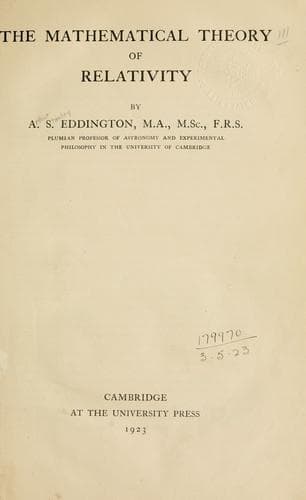
The Mathematical Theory of RelativityEddington, Arthur Stanley, Sir
Science
The Mathematical Theory of Relativity
Eddington, Arthur Stanley, Sir
Relativity (Physics)
The term gravitational mass can be used in two senses; it may refer to
\Item{(a)}~the response of a particle to a gravitational field of force, or \Item{(b)}~to its
power of producing a gravitational field of force. In the sense~\Item{(a)} its identity
with inertial mass is axiomatic in our theory, the separation of the field of
force from the inertial field being dependent on our arbitrary choice of
an abstract geometry. We accordingly use the term exclusively in the sense~\Item{(b)},
and we have shown in \SecRefs{38}, \SecNum{39} that the constant of integration~$m$ represents
the gravitational mass. But in the present discussion the $\rho_{0}$ which
occurs in the tensor~$T_{\mu\nu}$ refers to inertial mass defined by the conservation of
energy and momentum. The connection is made \Foreign{via} equation~\Eq{(54.3)}, where
on the left the mass appears in terms of~$g_{\mu\nu}$, i.e.\ in terms of its power of
exerting (or being accompanied by) a gravitational field; and on the right it
appears in the energy-tensor which comprises~$\rho_{0}$ according to~\Eq{(53.1)}. But it
will be remembered that the factor~$8\pi$ in~\Eq{(54.3)} was chosen arbitrarily, and
this must now be justified\footnotemark.\footnotetext
{It has been justified in \SecRef{46}, which has a close connection with the present paragraph; but
the argument is now proceeding in the reverse direction.}
This coefficient of proportionality corresponds to
the Newtonian constant of gravitation.
The proportionality of gravitational and inertial mass, and the ``constant
of gravitation'' which connects them, are conceptions belonging to the approximate
Newtonian scheme, and therefore presuppose that the gravitational
fields are so weak that the equations can be treated as linear. For more
intense fields the Newtonian terminology becomes ambiguous, and it is idle
to inquire whether the constant of gravitation really remains constant when
the mass is enormously great. Accordingly we here discuss only the limiting
case of very weak fields, and set
\[
g_{\mu\nu} = \delta_{\mu\nu} + h_{\mu\nu},
\Tag{(57.1)}
\]
where $\delta_{\mu\nu}$~represents Galilean values, and $h_{\mu\nu}$~will be a small quantity of the
first order whose square is neglected. The derivatives of the~$g_{\mu\nu}$ will be small
quantities of the first order.
We have, correct to the first order,
%[** TN: Not broken in the original]
\begin{align*}
G_{\mu\nu}
&= g^{\sigma\rho} B_{\mu\nu\sigma\rho} \\
&= \tfrac{1}{2}g^{\sigma\rho} \left(
\frac{\dd^{2} g_{\mu\nu}}{\dd x_{\sigma}\, \dd x_{\rho}}
+ \frac{\dd^{2} g_{\sigma\rho}}{\dd x_{\mu}\, \dd x_{\nu}}
- \frac{\dd^{2} g_{\mu\sigma}}{\dd x_{\nu}\, \dd x_{\rho}}
- \frac{\dd^{2} g_{\nu\rho}}{\dd x_{\mu}\, \dd x_{\sigma}}\right)
\Tag{(57.2)}
\end{align*}
by~\Eq{(34.5)}.
Public-domain text, read in full here on John Shaqi.
Reviews
Reviews
No reviews yet
Be the first to share your thoughts on this work.
Elsewhere in the archive
Join the Discussion
Join the discussion
Sign in to leave a comment or review.
Sign InorCreate an account