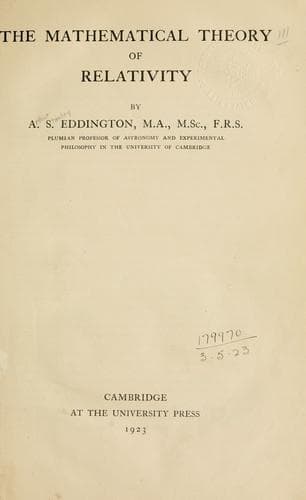
The Mathematical Theory of RelativityEddington, Arthur Stanley, Sir
Science
The Mathematical Theory of Relativity
Eddington, Arthur Stanley, Sir
Relativity (Physics)
We shall try to satisfy this by breaking it up into two equations
\[
G_{\mu\nu}
= \tfrac{1}{2}g^{\sigma\rho}\, \frac{\dd^{2} g_{\mu\nu}}{\dd x_{\sigma}\, \dd x_{\rho}}
\Tag{(57.31)}
\]
and
\[
0 = g^{\sigma\rho} \left(\frac{\dd^{2} g_{\sigma\rho}}{\dd x_{\mu}\, \dd x_{\nu}}
- \frac{\dd^{2} g_{\mu\sigma}}{\dd x_{\nu}\, \dd x_{\rho}}
- \frac{\dd^{2} g_{\nu\rho}}{\dd x_{\mu}\, \dd x_{\sigma}}\right).
\Tag{(57.32)}
\]
%\PageSep{129}
The second equation becomes, correct to the first order,
\begin{align*}
0 &= \delta^{\sigma\rho} \left(
\frac{\dd^{2} h_{\sigma\rho}}{\dd x_{\mu}\, \dd x_{\nu}}
- \frac{\dd^{2} h_{\mu\sigma}}{\dd x_{\nu}\, \dd x_{\rho}}
- \frac{\dd^{2} h_{\nu\rho}}{\dd x_{\mu}\, \dd x_{\sigma}}\right) \\
&= \frac{\dd^{2} h}{\dd x_{\mu}\, \dd x_{\nu}}
- \frac{\dd^{2} h_{\mu}^{\sigma}}{\dd x_{\nu}\, \dd x_{\rho}}
- \frac{\dd^{2} h_{\nu}^{\rho}}{\dd x_{\mu}\, \dd x_{\sigma}},
\end{align*}
where
\[
h_{\mu}^{\rho} = \delta^{\sigma\rho} h_{\mu\sigma};\quad
h = h_{\rho}^{\rho} = \delta^{\sigma\rho} h_{\sigma\rho}.
\]
This is satisfied if
\[
\frac{\dd h_{\mu}^{\alpha}}{\dd x_{\alpha}}
= \frac{1}{2}\, \frac{\dd h}{\dd x_{\mu}}
\]
or
\[
\frac{\dd}{\dd x_{\alpha}} (h_{\mu}^{\alpha} - \tfrac{1}{2} \delta_{\mu}^{\alpha} h) = 0.
\Tag{(57.4)}
\]
The other equation~\Eq{(57.31)} may be written
\[
\Wave h_{\mu\nu} = 2G_{\mu\nu}
\]
or
\[
\Wave h_{\mu}^{\alpha} = 2G_{\mu}^{\alpha},
\]
showing that $G_{\mu}^{\alpha}$~is a small quantity of the first order. Hence
\begin{align*}
\Wave (h_{\mu}^{\alpha} - \tfrac{1}{2} \delta_{\mu}^{\alpha} h)
&= 2(G_{\mu}^{\alpha} - \tfrac{1}{2} g_{\mu}^{\alpha} G) \\
&= -16\pi T_{\mu}^{\alpha}.
\Tag{(57.5)}
\end{align*}
This ``equation of wave-motion'' can be integrated. Since we are dealing
with small quantities of the first order, the effect of the deviations from
Galilean geometry will only affect the results to the second order; accordingly
the well-known solution\footnote
{Rayleigh, \Title{Theory of Sound}, vol.~\Vol{II}, p.~104, equation~(3).}
may be used, viz.\
\[
h_{\mu}^{\alpha} - \tfrac{1}{2} \delta_{\mu}^{\alpha} h
= \frac{1}{4\pi} \int \frac{(-16\pi T_{\mu}^{\alpha})'\, dV'}{r'},
\Tag{(57.6)}
\]
the integral being taken over each element of space-volume~$dV'$ at a coordinate
distance~$r'$ from the point considered and at a time $t - r'$, i.e.\ at a time
such that waves propagated from~$dV'$ with unit velocity can reach the point
at the time considered.
Public-domain text, read in full here on John Shaqi.
Reviews
Reviews
No reviews yet
Be the first to share your thoughts on this work.
Elsewhere in the archive
Join the Discussion
Join the discussion
Sign in to leave a comment or review.
Sign InorCreate an account