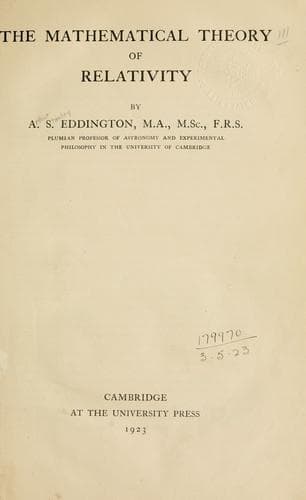
The Mathematical Theory of RelativityEddington, Arthur Stanley, Sir
Science
The Mathematical Theory of Relativity
Eddington, Arthur Stanley, Sir
Relativity (Physics)
If we calculate from~\Eq{(57.6)} the value of
\[
\frac{\dd}{\dd x_{\alpha}} (h_{\mu}^{\alpha} - \tfrac{1}{2} \delta_{\mu}^{\alpha} h),
\]
the operator~$\dd/\dd x_{\alpha}$ indicates a displacement in space and time of the point
considered, involving a change of~$r'$. We may, however, keep $r'$ constant on the
right-hand side and displace to the same extent the element~$dV'$ where $(T_{\mu}^{\alpha})'$~is
calculated. Thus
\[
\frac{\dd}{\dd x_{\alpha}} (h_{\mu}^{\alpha} - \tfrac{1}{2} \delta_{\mu}^{\alpha} h)
= -4\int \left\{\frac{\dd}{\dd x_{\alpha}}(T_{\mu}^{\alpha})\right\}' \frac{dV'}{r'}.
\]
But by~\Eq{(55.2)} $\dd T_{\mu}^{\alpha}/\dd x_{\alpha}$ is of the second order of small quantities, so that to our
approximation \Eq{(57.4)}~is satisfied.
\PageSep{130}
The result is that
\[
\Wave h_{\mu\nu} = 2G_{\mu\nu}
\Tag{(57.7)}
\]
satisfies the gravitational equations correctly to the first order, because both
the equations into which we have divided~\Eq{(57.2)} then become satisfied. Of
course there may be other solutions of~\Eq{(57.2)}, which do not satisfy \Eq{(57.31)}~and
\Eq{(57.32)} separately.
For a static field \Eq{(57.7)}~reduces to
\begin{align*}
-\nabla^{2} h_{\mu\nu}
&= 2G_{\mu\nu} \\
&= -16\pi (T_{\mu\nu} - \tfrac{1}{2} \delta_{\mu\nu}T)
\quad\text{by~\Eq{(54.5)}.}
\end{align*}
Also for matter at rest $T = T_{44} = \rho$ (the \emph{inertial} density) and the other components
of~$T_{\mu\nu}$ vanish; thus
\[
\nabla^{2} (h_{11}, h_{22}, h_{33}, h_{44}) = 8\pi\rho(1, 1, 1, 1).
\]
For a single particle the solution of this equation is well known to be
\[
h_{11}, h_{22}, h_{33}, h_{44} = -\frac{2m}{r}.
\]
Hence by~\Eq{(57.1)} the complete expression for the interval is
\[
ds^{2} = -\left(1 + \frac{2m}{r}\right)(dx^{2} + dy^{2} + dz^{2})
+ \left(1 - \frac{2m}{r}\right) dt^{2},
\Tag{(57.8)}
\]
agreeing with~\Eq{(46.15)}. But $m$~as here introduced is the inertial mass and not
\index{Gravitational mass of sun!equality with inertial mass}%
\index{Inertial mass!equal to gravitational mass}%
\index{Mass!gravitational and inertial}%
merely a constant of integration. We have shown in \SecRefs{38}, \SecNum{39} that the~$m$ in~\Eq{(46.15)}
is the gravitational mass reckoned with constant of gravitation unity.
Hence we see that inertial mass and gravitational mass are equal and expressed
in the same units, when the constant of proportionality between the
world-tensor and the physical-tensor is chosen to be~$8\pi$ as in~\Eq{(54.3)}.
Public-domain text, read in full here on John Shaqi.
Reviews
Reviews
No reviews yet
Be the first to share your thoughts on this work.
Elsewhere in the archive
Join the Discussion
Join the discussion
Sign in to leave a comment or review.
Sign InorCreate an account