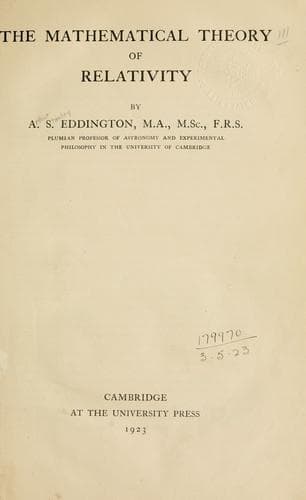
The Mathematical Theory of RelativityEddington, Arthur Stanley, Sir
Science
The Mathematical Theory of Relativity
Eddington, Arthur Stanley, Sir
Relativity (Physics)
In empty space the expression for~$\mf{t}_{\mu}^{\nu}$ can be simplified. Since $\mf{G} = 0$, \Eq{(58.8)}~becomes
\[
\mf{L} = \frac{\dd}{\dd x_{\nu}} \left(\mf{g}^{\alpha\beta}\, \frac{\dd\mf{L}}{\dd\mf{g}_{\nu}^{\alpha\beta}}\right).
\]
Hence
\begin{align*}
16\pi\mf{t}_{\mu}^{\nu}
&= \frac{\dd}{\dd x_{\mu}}\left(\mf{g}^{\alpha\beta}\, \frac{\dd\mf{L}}{\dd\mf{g}_{\nu}^{\alpha\beta}}\right)
- \mf{g}_{\mu}^{\alpha\beta}\, \frac{\dd\mf{L}}{\dd\mf{g}_{\nu}^{\alpha\beta}}\displaybreak[0] \\
&= \mf{g}^{\alpha\beta}\, \frac{\dd}{\dd x_{\mu}}\, \frac{\dd\mf{L}}{\dd\mf{g}_{\nu}^{\alpha\beta}}\displaybreak[0] \\
&= \mf{g}^{\alpha\beta}\, \frac{\dd}{\dd x_{\mu}} \left[
-\{\alpha\beta, \nu\} + g_{\alpha}^{\nu} \frac{\dd}{\dd x_{\beta}} \log \sqrt{-g}\right]
\Tag{(59.6)}
\end{align*}
by~\Eq{(58.52)}.
\Section{60.}{Action}
The invariant integral
\[
A = \iiiint \rho_{0} \sqrt{-g}\, d\tau
\Tag{(60.11)}
\]
represents the \emph{action} of the matter in a four-dimensional region.
By~\Eq{(49.42)},
\begin{align*}
A &= \iiiint \rho_{0}\, dW\, ds \\
&= \iint m\, ds,
\Tag{(60.12)}
\end{align*}
where $m$~is the invariant mass or energy.
Thus the action of a particle having energy~$m$ for a proper-time~$ds$ is
equal to~$m\, ds$, agreeing with the definition of action in ordinary mechanics as
energy multiplied by time. By~\Eq{(54.6)} another form is
\[
A = \frac{1}{8\pi} \iiiint G\sqrt{-g}\, d\tau,
\Tag{(60.2)}
\]
so that (ignoring the numerical factor) $G\sqrt{-g}$, or~$\mf{G}$, represents the action-density
of the gravitational field. Note that material action and gravitational
action are alternative aspects of the same thing; they are not to be added
together to give a total action.
But in stating that the gravitational action and the material action are
necessarily the same thing, we have to bear in mind a very peculiar conception
which is almost always associated with the term Action. From its first introduction,
action has always been looked upon as something whose sole \Foreign{raison
\Typo{d'étre}{d'être}} is to be varied---and, moreover, \emph{varied in such a way as to defy the laws
\PageSep{138}
of nature!} We have thus to remember that when a writer begins to talk
about action, he is probably going to consider impossible conditions of the
world. (That does not mean that he is talking nonsense---he brings out the
important features of the possible conditions by comparing them with impossible
conditions.) Thus we may not always \emph{disregard} the difference between material
and gravitational action; it is impossible that there should be any difference,
but then we are about to discuss impossibilities.
Public-domain text, read in full here on John Shaqi.
Reviews
Reviews
No reviews yet
Be the first to share your thoughts on this work.
Elsewhere in the archive
Join the Discussion
Join the discussion
Sign in to leave a comment or review.
Sign InorCreate an account