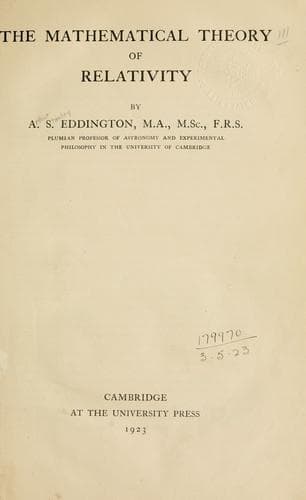
The Mathematical Theory of RelativityEddington, Arthur Stanley, Sir
Science
The Mathematical Theory of Relativity
Eddington, Arthur Stanley, Sir
Relativity (Physics)
We have to bear in mind the two aspects of action in this subject. It is
primarily a physical quantity having a definite numerical value, given indifferently
by \Eq{(60.11)} or~\Eq{(60.2)}, which is of special importance because it is
invariant. But it also denotes a mathematical function of the variables; the
functional form, which is all important, will differ according to which of the
two expressions is used. In particular we have to consider the partial derivatives,
and these will depend on the variables in terms of which the action is
expressed.
The Hamiltonian method of variation of an integral is of great importance
in this subject; several examples of it will be given presently. I think it is
unfortunate that this valuable method is nearly always applied in the form of
a principle of stationary action. By considering the variation of the integral
for small variations of the~$g_{\mu\nu}$, or other variables, we obtain a kind of generalised
differential coefficient which I will call the Hamiltonian derivative. It
may be possible to construct integrals for which the Hamiltonian derivatives
vanish, so that the integral has the stationary property. But just as in the
ordinary differential calculus we are not solely concerned with problems of
maxima and minima, and we take some interest in differential coefficients
which do not vanish; so Hamiltonian derivatives may be worthy of attention
even when they disappoint us by failing to vanish.
Let us consider the variation of the gravitational action in a region, viz.\
\[
8\pi\, \delta A = \delta \int G\sqrt{-g}\, d\tau,
\]
for arbitrary small variations~$\delta g_{\mu\nu}$ which vanish at and near\footnote
{So that their first derivatives also vanish.}
the boundary of
the region. By~\Eq{(58.8)}
\[
\delta \int G\sqrt{-g}\, d\tau
= -\delta \int \mf{L}\, d\tau
+ \delta \int \frac{\dd}{\dd x_{\alpha}} \left(\mf{g}^{\mu\nu}\, \frac{\dd\mf{L}}{\dd\mf{g}_{\alpha}^{\mu\nu}}\right) d\tau.
\]
Also since $\mf{L}$~is a function of $\mf{g}^{\mu\nu}$ and~$\mf{g}_{\alpha}^{\mu\nu}$
\[
\int \delta\mf{L}\, d\tau
= \int \left(
\frac{\dd\mf{L}}{\dd\mf{g}^{\mu\nu}}\, \delta\mf{g}^{\mu\nu}
+ \frac{\dd\mf{L}}{\dd\mf{g}_{\alpha}^{\mu\nu}}\, \delta\mf{g}_{\alpha}^{\mu\nu}
\right) d\tau,
\]
and, by partial integration of the second term,
\[
= \int \left(
\frac{\dd\mf{L}}{\dd\mf{g}^{\mu\nu}}
- \frac{\dd}{\dd x_{\alpha}}\, \frac{\dd\mf{L}}{\dd\mf{g}_{\alpha}^{\mu\nu}}\right) \delta\mf{g}^{\mu\nu}\, d\tau
+ \int \frac{\dd}{\dd x_{\alpha}} \left(\frac{\dd\mf{L}}{\dd\mf{g}_{\alpha}^{\mu\nu}}\, \delta\mf{g}^{\mu\nu}\right) d\tau.
\]
\PageSep{139}
By~\Eq{(58.6)} the first integrand becomes $-G_{\mu\nu}\, \delta\mf{g}^{\mu\nu}$, so that we have
\[
\delta \int G\sqrt{-g}\, d\tau
= \int G_{\mu\nu}\, \delta(g^{\mu\nu} \sqrt{-g})\, d\tau
+ \int \frac{\dd}{\dd x_{\alpha}} \left(\mf{g}^{\mu\nu}\, \delta\left(\frac{\dd\mf{L}}{\dd\mf{g}_{\alpha}^{\mu\nu}}\right)\right) d\tau.
\Tag{(60.3)}
\]
Public-domain text, read in full here on John Shaqi.
Reviews
Reviews
No reviews yet
Be the first to share your thoughts on this work.
Elsewhere in the archive
Join the Discussion
Join the discussion
Sign in to leave a comment or review.
Sign InorCreate an account