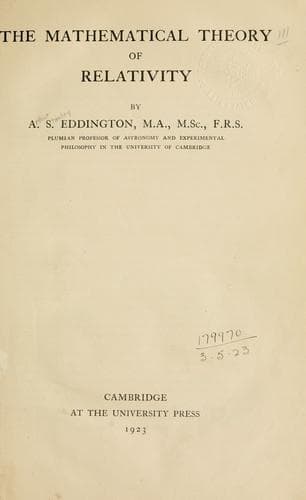
The Mathematical Theory of RelativityEddington, Arthur Stanley, Sir
Science
The Mathematical Theory of Relativity
Eddington, Arthur Stanley, Sir
Relativity (Physics)
It is not suggested that there is anything incorrect in the principle of
least action as used in classical mechanics. The break-down occurs when we
attempt to generalise it for variations of the state of the system beyond those
hitherto contemplated. Indeed it is obvious that the principle must break
down if pressed to extreme generality. We may discriminate \Item{(a)}~possible
states of the world, \Item{(b)}~states which although impossible are contemplated,
\Item{(c)}~impossible states which are not contemplated. Generalisation of the principle
consists in transferring states from class~\Item{(c)} to class~\Item{(b)}; there must be
some limit to this, for otherwise we should find ourselves asserting that the
equation $\delta A \neq 0$ is not merely not a possible equation but also not even an
impossible equation.
\PageSep{140}
\Section{61.}{A property of invariants}
Let $K$~be any invariant function of the~$g_{\mu\nu}$ and their derivatives up to any
order, so that
\[
\int K \sqrt{-g}\, d\tau\quad\text{is an invariant.}
\]
The small variations $\delta(K \sqrt{-g})$ can be expressed as a linear sum of terms
involving $\delta g_{\mu\nu}$, $\delta(\dd g_{\mu\nu}/dx_{\alpha})$, $\delta(\dd^{2} g_{\mu\nu}/dx_{\alpha}\, dx_{\beta})$, etc. By the usual method of partial
integration employed in the calculus of variations, these can all be reduced to
terms in~$\delta g_{\mu\nu}$, together with complete differentials.
Thus for variations which vanish at the boundary of the region, we can
write
\[
\delta \int K \sqrt{-g}\, d\tau
= \int P^{\mu\nu}\, \delta g_{\mu\nu}\, \sqrt{-g}\, d\tau,
\Tag{(61.1)}
\]
where the coefficients, here written~$P^{\mu\nu}$, can be evaluated when the analytical
expression for~$K$ is given. The complete differentials yield surface-integrals
over the boundary, so that they do not contribute to the variations. In
accordance with our previous notation \Eq{(60.43)}, we have
\[
P^{\mu\nu} = \frac{\Ham K}{\Ham g_{\mu\nu}}.
\Tag{(61.2)}
\]
We take $P^{\mu\nu}$ to be symmetrical in $\mu$ and~$\nu$, since any antisymmetrical part
would be meaningless owing to the inner multiplication by~$\delta g_{\mu\nu}$. Also since
$\delta g_{\mu\nu}$ is an arbitrary tensor $P^{\mu\nu}$~must be a tensor.
Consider the case in which the $\delta g_{\mu\nu}$ arise merely from a transformation of
coordinates. Then \Eq{(61.1)}~vanishes, not from any stationary property, but
because of the invariance of~$K$. The $\delta g_{\mu\nu}$ are not now arbitrary independent
variations, so that it does not follow that $P^{\mu\nu}$~vanishes.
Public-domain text, read in full here on John Shaqi.
Reviews
Reviews
No reviews yet
Be the first to share your thoughts on this work.
Elsewhere in the archive
Join the Discussion
Join the discussion
Sign in to leave a comment or review.
Sign InorCreate an account