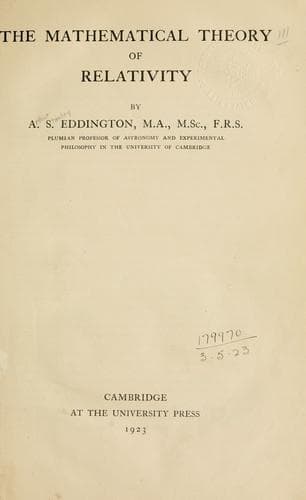
The Mathematical Theory of RelativityEddington, Arthur Stanley, Sir
Science
The Mathematical Theory of Relativity
Eddington, Arthur Stanley, Sir
Relativity (Physics)
The second term can be integrated immediately giving a triple integral over
the boundary of the four-dimensional region; and it vanishes because all
variations vanish at the boundary by hypothesis. Hence
\begin{align*}
\delta \int G\sqrt{-g}\, d\tau
&= \Neg \int G_{\mu\nu}\, \delta(g^{\mu\nu} \sqrt{-g})\, d\tau
\Tag{(60.41)} \\
&= -\int (G_{\mu\nu} - \tfrac{1}{2}g^{\mu\nu}G)\, \delta g_{\mu\nu} \sqrt{-g}\, d\tau
\Tag{(60.42)}
\end{align*}
by~\Eq{(58.91)}.
I call the coefficient $-(G^{\mu\nu} - \frac{1}{2}g^{\mu\nu}G)$ the \emph{Hamiltonian derivative} of~$G$ with
\index{H@$\Ham$ (Hamiltonian operator)}%
\index{Hamiltonian derivative}%
\index{Operators!H@$\Ham$}%
respect to~$g_{\mu\nu}$, writing it symbolically
\[
\frac{\Ham G}{\Ham g_{\mu\nu}}
= -(G^{\mu\nu} - \tfrac{1}{2}g^{\mu\nu}G)
= 8\pi T^{\mu\nu}.
\Tag{(60.43)}
\]
We see from~\Eq{(60.42)} that the action~$A$ is only stationary when the energy-tensor~$T^{\mu\nu}$
\index{Action, principle of Stationary}%
\index{Stationary action, principle of}%
vanishes, that is to say in empty space. In fact action is only
stationary when it does not exist---and not always then.
It would thus appear that the Principle of Stationary Action is in general
\index{Principle!of least action}%
untrue. Nevertheless some modified statement of the principle appears to
have considerable significance. In the actual world the space occupied by
matter (electrons) is extremely small compared with the empty regions. Thus
the Principle of Stationary Action, although not universally true, expresses a
very general tendency---a tendency with exceptions\footnotemark.\footnotetext
{I do not regard electromagnetic fields as constituting an exception, because they have not
yet been taken into account in our work. But the action of matter has been fully included, so
that the break-down of the principle as applied to matter is a definite exception.}
Our theory does not
account for this atomicity of matter; and in the stationary variation of action
\index{Atomicity}%
we seem to have an indication of a way of approaching this difficult problem,
although the precise formulation of the law of atomicity is not yet achieved.
It is suspected that it may involve an ``action'' which is capable only of
discontinuous variation.
Public-domain text, read in full here on John Shaqi.
Reviews
Reviews
No reviews yet
Be the first to share your thoughts on this work.
Elsewhere in the archive
Join the Discussion
Join the discussion
Sign in to leave a comment or review.
Sign InorCreate an account