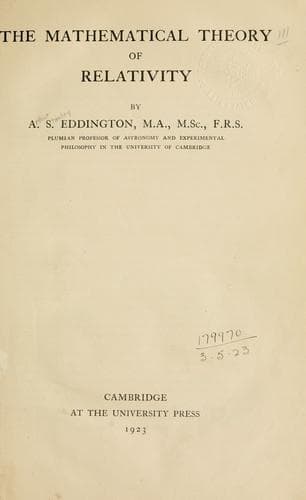
The Mathematical Theory of RelativityEddington, Arthur Stanley, Sir
Science
The Mathematical Theory of Relativity
Eddington, Arthur Stanley, Sir
Relativity (Physics)
The two alternative tensors are excessively complicated expressions; but
when applied to determine the field of an isolated particle, they become not
unmanageable. The field, being symmetrical, must be of the general form~\Eq{(38.2)},
so that we have only to determine the disposable coefficients $\lambda$ and~$\nu$
both of which must be functions of $r$~only. $K'$~can be calculated in terms of
$\lambda$ and~$\nu$ without difficulty from equations~\Eq{(38.6)}; but the expression for~$K''$
turns out to be rather simpler and I shall deal with it. By the method of
\SecRef{38}, we find
%[** TN: Re-breaking]
\begin{multline*}
\mf{K}''
= K'' \sqrt{-g}
= 2e^{\frac{1}{2}(\lambda + \nu)} \sin\theta
\bigl\{e^{-2\lambda} (\lambda'^{2} + \nu'^{2}) \\
+ 2r^{2} e^{-2\lambda} (\tfrac{1}{4}\lambda'\nu' - \tfrac{1}{4}\nu'^{2} - \tfrac{1}{2}\nu'')^{2}
+ 2(1 - e^{-\lambda})^{2}/r^{2}\bigr\}.
\Tag{(62.3)}
\end{multline*}
It is clear that the integral of~$\mf{K}''$ will be stationary for variations from the
symmetrical condition, so that we need only consider variations of $\lambda$ and $\nu$
and their derivatives with respect to~$r$. Thus the gravitational equations
$\Ham\mf{K}''/\Ham g_{\mu\nu} = 0$ are equivalent to
\[
\frac{\Ham K''}{\Ham \lambda} = 0,\quad
\frac{\Ham K''}{\Ham \nu} = 0.
\Tag{(62.4)}
\]
Now for a variation of~$\lambda$
\begin{align*}
\delta\! \int\!\! \mf{K}\, d\tau
&=\!\! \int\!\! \biggl(\frac{\dd\mf{K}}{\dd\lambda}\, \delta\lambda
+ \frac{\dd\mf{K}}{\dd\lambda'}\, \delta\lambda'
+ \frac{\dd\mf{K}}{\dd\lambda''}\, \delta\lambda''\biggr) d\tau\displaybreak[0] \\
&=\!\! \int\!\! \left\{\frac{\dd\mf{K}}{\dd\lambda}
- \frac{\dd}{\dd r} \biggl(\frac{\dd\mf{K}}{\dd\lambda'}\biggr)
+ \frac{\dd^{2}}{\dd r^{2}} \biggl(\frac{\dd\mf{K}}{\dd\lambda''}\biggr)\!\!\right\} \delta\lambda\, d\tau
+ \text{surface-integrals.}
\end{align*}
Hence our equations~\Eq{(62.4)} take the Lagrangian form
\[
\left.
\begin{alignedat}{4}
\frac{\Ham K''}{\Ham\lambda}
&= \frac{\dd\mf{K}''}{\dd\lambda}
&&-\frac{\dd}{\dd r} \frac{\dd\mf{K}''}{\dd\lambda'}
&&+ \frac{\dd^{2}}{\dd r^{2}} \frac{\dd\mf{K}''}{\dd\lambda''}
&&= 0\Add{,} \\
\frac{\Ham K''}{\Ham\nu}
&= \frac{\dd\mf{K}''}{\dd\nu}
&&-\frac{\dd}{\dd r} \frac{\dd\mf{K}''}{\dd\nu'}
&&+ \frac{\dd^{2}}{\dd r^{2}} \frac{\dd\mf{K}''}{\dd\nu''}
&&= 0.
\end{alignedat}
\right\}
\Tag{(62.5)}
\]
From these $\lambda$ and $\nu$ are to be determined.
Public-domain text, read in full here on John Shaqi.
Reviews
Reviews
No reviews yet
Be the first to share your thoughts on this work.
Elsewhere in the archive
Join the Discussion
Join the discussion
Sign in to leave a comment or review.
Sign InorCreate an account