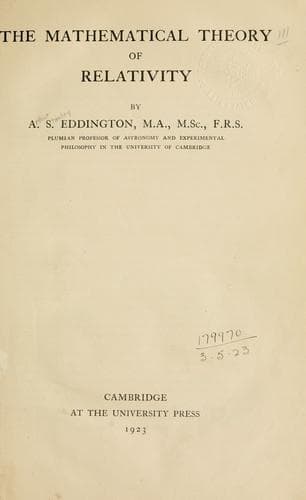
The Mathematical Theory of RelativityEddington, Arthur Stanley, Sir
Science
The Mathematical Theory of Relativity
Eddington, Arthur Stanley, Sir
Relativity (Physics)
It can be shown that one exact solution is the same as in \SecRef{38}, viz.\
\[
e^{-\lambda} = e^{\nu} = \gamma = 1 - 2m/r.
\Tag{(62.6)}
\]
For taking the partial derivatives of~\Eq{(62.3)}, and applying \Eq{(62.6)} after the
differentiation,
\begin{align*}
\frac{\dd\mf{K}''}{\dd\lambda}
&= -\tfrac{3}{2} \mf{K}'' + 4 \frac{(1 - e^{-\lambda})}{r^{4}} · 2e^{\frac{1}{2}(\lambda + \nu)} \sin\theta
= \left(-72 \frac{m^{2}}{r^{4}} + 16 \frac{m}{r^{3}}\right) \sin\theta,\displaybreak[0] \\
%
\frac{\dd\mf{K}''}{\dd\lambda'}
&= 2e^{\frac{1}{2}(\lambda + \nu)} \sin\theta
\bigl\{2e^{-2\lambda} \lambda' + r^{2} e^{-2\lambda}(\tfrac{1}{4}\lambda'\nu' - \tfrac{1}{4}\nu'^{2} - \tfrac{1}{2}\nu'')\nu'\bigr\} \\
&= \left(24 \frac{m^{2}}{r^{3}} - 8 \frac{m}{r^{2}}\right) \sin\theta,\displaybreak[0] \\
%\PageSep{143}
\index{Einstein's law of gravitation!alternatives to}%
\frac{\dd\mf{K}''}{\dd\lambda''} &= 0,\displaybreak[0] \\
%
\frac{\dd\mf{K}''}{\dd\nu}
&= \tfrac{1}{2} \mf{K}''
= 24 \frac{m^{2}}{r^{4}} \sin\theta,\displaybreak[0] \\
%
\frac{\dd\mf{K}''}{\dd\nu'}
&= 2e^{\frac{1}{2}(\lambda + \nu)} \sin\theta
\bigl\{2e^{-2\lambda} \nu' + 4r^{2} e^{-2\lambda}(\tfrac{1}{4}\lambda'\nu' - \tfrac{1}{4}\nu'^{2} - \tfrac{1}{2}\nu'') (\tfrac{1}{4}\lambda' - \tfrac{1}{2}\nu')\bigr\} \\
&= \left(-40 \frac{m^{2}}{r^{3}} + 8\frac{m}{r^{2}}\right) \sin\theta,\displaybreak[0] \\
%
\frac{\dd\mf{K}''}{\dd\nu''}
&= -2e^{\frac{1}{2}(\lambda + \nu)} \sin\theta
· 2r^{2} e^{-2\lambda}(\tfrac{1}{4}\lambda'\nu' - \tfrac{1}{4}\nu'^{2} - \tfrac{1}{2}\nu'') \\
&= \left(16 \frac{m^{2}}{r^{2}} - 8\frac{m}{r}\right) \sin\theta.
\end{align*}
On substituting these values, \Eq{(62.5)}~is verified exactly.
The alternative law $\Ham K'/\Ham g_{\mu\nu} = 0$ is also satisfied by the same solution.
For
\[
\delta(G_{\mu\nu} G^{\mu\nu} \sqrt{-g})
= G_{\mu\nu}\, \delta(G^{\mu\nu} \sqrt{-g}) + G^{\mu\nu} \sqrt{-g}\, \delta G_{\mu\nu},
\]
hence the variation of $K' \sqrt{-g}$ vanishes wherever $G_{\mu\nu} = 0$. Any field of gravitation
agreeing with Einstein's law will satisfy the alternative law proposed,
but not usually \Foreign{vice versa}.
There are doubtless other symmetrical solutions for the alternative laws
of gravitation which are not permitted by Einstein's law, since the differential
equations are now of the fourth order and involve two extra boundary conditions
either at the particle or at infinity. It may be asked, Why should
these be excluded in nature? We can only answer that it may be for the
same reason that negative mass, doublets, electrons of other than standard
mass, or other theoretically possible singularities in the world, do not occur;
the ultimate particle satisfies conditions which are at present unknown to us.
Public-domain text, read in full here on John Shaqi.
Reviews
Reviews
No reviews yet
Be the first to share your thoughts on this work.
Elsewhere in the archive
Join the Discussion
Join the discussion
Sign in to leave a comment or review.
Sign InorCreate an account