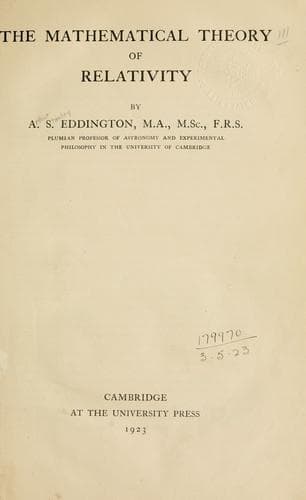
The Mathematical Theory of RelativityEddington, Arthur Stanley, Sir
Science
The Mathematical Theory of Relativity
Eddington, Arthur Stanley, Sir
Relativity (Physics)
It would seem therefore that there are three admissible laws of gravitation~\Eq{(62.2)}.
Each can give precisely the same gravitational field of the sun, and
all astronomical phenomena are the same whichever law is used. Small
differences may appear in the cross-terms due to two or more attracting
bodies; but as was shown in our discussion of the lunar theory these are too
small to be detected by astronomical observation. Each law gives precisely
the same mechanical phenomena, since the conservation of energy and
momentum is satisfied. When we ask which of the three is the law of the
actual world, I am not sure that the question has any meaning. The subject
is very mystifying, and the following suggestions are put forward very
tentatively.
The energy-tensor has been regarded as giving the definition of matter,
since it comprises the properties by which matter is described in physics.
Our three energy-tensors give us three alternative material worlds; and the
question is which of the three are we looking at when we contemplate the
world around us; but if these three material worlds are each doing the same
thing (within the limits of observational accuracy) it seems impossible to
decide whether we are observing one or other or all three.
\PageSep{144}
To put it another way, an observation involves the relation of the~$T_{\mu}^{\nu}$ of
our bodies to the~$T_{\mu}^{\nu}$ of external objects, or alternatively of the respective
${T'}_{\mu}^{\nu}$ or~${T''}_{\mu}^{\nu}$. If these are the same relation it seems meaningless to ask which
of the three bodies and corresponding worlds the relation is between. After
all it is the relation which is the reality. In accepting $T_{\mu}^{\nu}$ as the energy-tensor
we are simply choosing the simplest of three possible modes of representing
the observation.
One cannot but suspect that there is some identical relation between the
Hamiltonian derivatives of the three fundamental invariants. If this relation
were discovered it would perhaps clear up a rather mysterious subject.
\Section{63.}{Gravitational flux from a particle}
\index{Flux!gravitational}%
\index{Gravitational flux}%
Public-domain text, read in full here on John Shaqi.
Reviews
Reviews
No reviews yet
Be the first to share your thoughts on this work.
Elsewhere in the archive
Join the Discussion
Join the discussion
Sign in to leave a comment or review.
Sign InorCreate an account