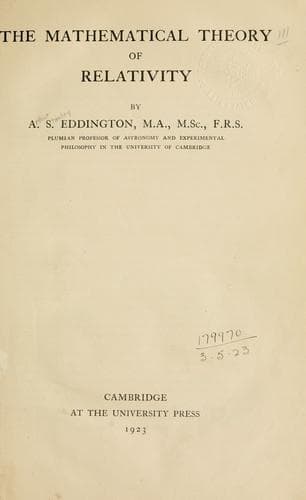
The Mathematical Theory of RelativityEddington, Arthur Stanley, Sir
Science
The Mathematical Theory of Relativity
Eddington, Arthur Stanley, Sir
Relativity (Physics)
Calculating the Riemann-Christoffel tensor by~\Eq{(34.5)}, since the first derivatives
vanish,
\begin{align*}
B_{\mu\nu\sigma\rho}
&= \frac{1}{2}\left(\frac{\dd g_{\sigma\rho}}{\dd x_{\mu}\, \dd x_{\nu}}
+ \frac{\dd g_{\mu\nu}}{\dd x_{\sigma}\, \dd x_{\rho}}
- \frac{\dd g_{\mu\sigma}}{\dd x_{\nu}\, \dd x_{\rho}}
- \frac{\dd g_{\nu\rho}}{\dd x_{\mu}\, \dd x_{\sigma}}\right) \\
&= a_{\mu\nu} a_{\sigma\rho} - a_{\mu\sigma} a_{\nu\rho}.
\Tag{(65.51)}
\end{align*}
\PageSep{151}
Hence, remembering that the~$g^{\tau\rho}$ have Euclidean values~$-g_{\sigma}^{\rho}$,
\[
G_{\mu\nu} = g^{\sigma\rho} B_{\mu\nu\sigma\rho}
= -a_{\mu\nu} (a_{11} + a_{22} + a_{33} + a_{44}) + a_{\mu\sigma} a_{\nu\sigma}.
\Tag{(65.52)}
\]
In particular
\begin{align*}
G_{11}
&= -a_{11} (a_{11} + a_{22} + a_{33} + a_{44}) + a_{11}^{2} + a_{12}^{2} + a_{13}^{2} + a_{14}^{2} \\
&= (a_{12}^{2} - a_{11} a_{22}) + (a_{13}^{2} - a_{11} a_{33}) + (a_{14}^{2} - a_{11} a_{44}).
\Tag{(65.53)}
\end{align*}
Also
%[** TN: Re-breaking]
\begin{align*}
G &= g^{\mu\nu} G_{\mu\nu}
= -G_{11} - G_{22} - G_{33} - G_{44} \\
&= -2 \bigl\{(a_{12}^{2} - a_{11} a_{22}) + (a_{13}^{2} - a_{11} a_{33}) + (a_{14}^{2} - a_{11} a_{44}) \\
&\qquad + (a_{23}^{2} - a_{22} a_{33}) + (a_{24}^{2} - a_{22} a_{44}) + (a_{34}^{2} - a_{33} a_{44})\bigr\}.
\Tag{(65.54)}
\end{align*}
When the principal axes are taken as in~\Eq{(65.3)}, these results become
\[
\left.
\begin{aligned}
G_{11} &= -k_{1}(k_{2} + k_{3} + k_{4})\Add{,} \\
G_{22} &= -k_{2}(k_{1} + k_{3} + k_{4});\ \text{etc.}
\end{aligned}
\right\}
\Tag{(65.55)}
\]
and
\[
G = 2(k_{1}k_{2} + k_{1}k_{3} + k_{1} k_{4} + k_{2} k_{3} + k_{2} k_{4} + k_{3} k_{4}).
\Tag{(65.6)}
\]
The invariant~$G$ has thus a comparatively simple interpretation in terms
of the principal radii of curvature. It is a generalisation of the well-known
\index{Curvature!radius of spherical}%
\index{Spherical curvature, radius of}%
invariant for two-dimensional surfaces $1/\rho_{1}\rho_{2}$, or~$k_{1} k_{2}$. But this interpretation
is only possible in the simple case of five dimensions. In general five dimensions
are not sufficient to represent even the small portion of the surface near the
origin; for if we set $G_{\mu\nu} = 0$ in~\Eq{(65.55)}, we obtain $k_{\mu} = 0$, and hence by~\Eq{(65.51)}
$B_{\mu\nu\sigma\rho} = 0$. Thus it is not possible to represent a natural gravitational field
($G_{\mu\nu} = 0$, $B_{\mu\nu\sigma\rho} \neq 0$) in five Euclidean dimensions.
Public-domain text, read in full here on John Shaqi.
Reviews
Reviews
No reviews yet
Be the first to share your thoughts on this work.
Elsewhere in the archive
Join the Discussion
Join the discussion
Sign in to leave a comment or review.
Sign InorCreate an account