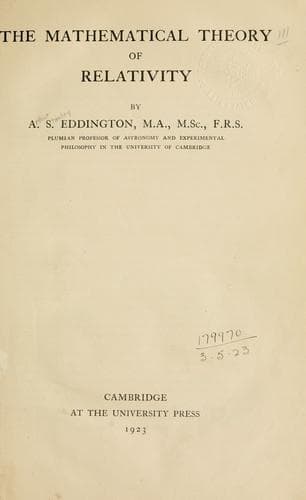
The Mathematical Theory of RelativityEddington, Arthur Stanley, Sir
Science
The Mathematical Theory of Relativity
Eddington, Arthur Stanley, Sir
Relativity (Physics)
At the ``horizon'' $\chi = \frac{1}{2}\pi$, any finite value of~$ds$ corresponds to an infinite~$dt$.
It takes an infinite ``time'' for anything to happen. All the processes of
nature have come to a standstill so far as the observer at the origin can have
evidence of them.
But we must recall that by the symmetry of the original formula~\Eq{(67.31)},
any point of space and time could be chosen as origin with similar results.
Thus there can be no actual difference in the natural phenomena at the horizon
and at the origin. The observer on the horizon does not perceive the stoppage---in
fact he has a horizon of his own at a distance~$\frac{1}{2}\pi R$ where things appear
to him to have come to a standstill.
Let us send a ray of light from the origin to the horizon and back again.
(We take the double journey because the time-lapse can then be recorded by
a single clock at the origin; the physical significance of the time for a single
journey is less obvious.) Setting $ds = 0$, the velocity of the light is given by
\[
0 = -R^{2}\, d\chi^{2} + R^{2} \cos^{2}\chi\, dt^{2},
\]
so that
\[
dt = ±\sec\chi\, d\chi,
\]
whence
\[
t = ±\log\tan(\tfrac{1}{4}\pi + \tfrac{1}{2}\chi).
\Tag{(67.5)}
\]
This must be taken between the limits $\chi = 0$ and~$\frac{1}{2}\pi$; and again with reversed
sign between the limits $\frac{1}{2}\pi$ and~$0$. The result is infinite, and the journey can
never be completed.
De~Sitter accordingly dismisses the paradox of the arrest of time at the
horizon with the remark that it only affects events which happen before the
beginning or after the end of eternity. But we shall discuss this in greater
detail in \SecRef{70}.
\Section{68.}{Elliptical space}
\index{Elliptical space}%
The equation~\Eq{(67.11)} for spherical space, which appears in both de~Sitter's
and Einstein's form of the interval, can also be construed as representing a
slightly modified kind of space called ``elliptical space.'' From the modern
standpoint the name is rather unfortunate, and does not in any way suggest
its actual nature. We can approach the problem of elliptical space in the
following way---
Public-domain text, read in full here on John Shaqi.
Reviews
Reviews
No reviews yet
Be the first to share your thoughts on this work.
Elsewhere in the archive
Join the Discussion
Join the discussion
Sign in to leave a comment or review.
Sign InorCreate an account