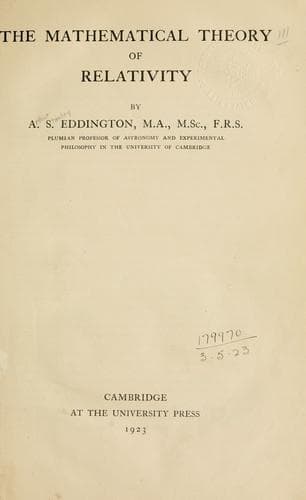
The Mathematical Theory of RelativityEddington, Arthur Stanley, Sir
Science
The Mathematical Theory of Relativity
Eddington, Arthur Stanley, Sir
Relativity (Physics)
Suppose that in spherical space the physical processes going on at every
point are exactly the same as those going on at the antipodal point, so that
\PageSep{158}
one half of the world is an exact replica of the other half. Let $ABA'B'$ be
four points $90°$~apart on a great circle. Let us proceed from~$B'$, \Foreign{via}~$A$, to~$B$;
on continuing the journey along~$BA'$ it is impossible to tell that we are not
repeating the journey $B'A$~already performed. We should be tempted to think
that the arc~$B'A$ was in fact the immediate continuation of~$AB$, $B$~and $B'$
being the same point and only represented as wide apart through some fault
in our projective representation---just as in a Mercator Chart we see the same
Behring Sea represented at both edges of the map. We may leave to the
metaphysicist the question whether two objects can be exactly alike, both
intrinsically and in relation to all surroundings, and yet differ in identity;
physics has no conception of what is meant by this mysterious differentiation
of identity; and in the case supposed, physics would unhesitatingly declare
that the observer was re-exploring the same hemisphere.
Thus the spherical world in the case considered does not consist of two
similar halves, but of a single hemisphere imagined to be repeated twice over
for convenience of projective representation. The differential geometry is the
same as for a sphere, as given by~\Eq{(67.11)}, but the \emph{connectivity} is different; just
as a plane and a cylinder have the same differential geometry but different
connectivity. At the limiting circle of any hemisphere there is a cross-connection
of opposite ends of the diameters which it is impossible to represent
graphically; but that is, of course, no reason against the existence of the
cross-connection.
This hemisphere which returns on itself by cross-connections is the type
of elliptical space. In what follows we shall not need to give separate consideration
to elliptical space. It is sufficient to bear in mind that in adopting
spherical space we may be representing the physical world in duplicate; for
example, the volume $2\pi^{2} R^{3}$ already given may refer to the duplicated world.
Public-domain text, read in full here on John Shaqi.
Reviews
Reviews
No reviews yet
Be the first to share your thoughts on this work.
Elsewhere in the archive
Join the Discussion
Join the discussion
Sign in to leave a comment or review.
Sign InorCreate an account