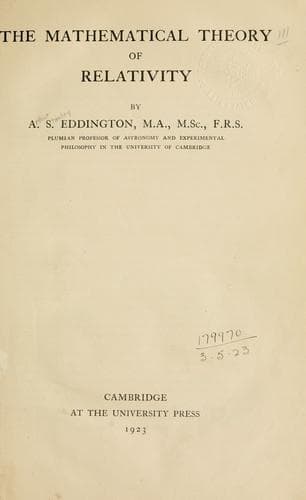
The Mathematical Theory of RelativityEddington, Arthur Stanley, Sir
Science
The Mathematical Theory of Relativity
Eddington, Arthur Stanley, Sir
Relativity (Physics)
The coordinate-frame $(r, t)$ of a single observer does not cover the whole
world. The range from $t = -\infty$ to $t = +\infty$ corresponds to values of~$\xi/z$
between~$±1$. The whole experience of any one observer of infinite longevity
is comprised within a $90°$~lune. Changing the origin we can have another
observer whose experience covers a different lune. The two observers cannot
communicate the non-overlapping parts of their experience, since there are
no light-tracks (generators) taking the necessary course.
A further question has been raised, Is de~Sitter's world really empty? In
\index{Horizon of world}%
\index{Mass-horizon of world}%
formula~\Eq{(70.1)} there is a singularity at $r = \Chg{\surd(3/\lambda)}{\sqrt{3/\lambda}}$ similar to the singularity
at $r = 2m$ in the solution for a particle of matter. Must we not suppose that
the former singularity also indicates matter---a ``mass-horizon'' or ring of
peripheral matter necessary in order to distend the empty region within. If
so, it would seem that de~Sitter's world cannot exist without large quantities
of matter any more than Einstein's; he has merely swept the dust away into
unobserved corners.
A singularity of~$ds^{2}$ does not necessarily indicate material particles, for
we can introduce or remove such singularities by making transformations of
coordinates. It is impossible to know whether to blame the world-structure
or the inappropriateness of the coordinate-system. In a finite region we avoid
this difficulty by choosing a coordinate-system initially appropriate---how this
\PageSep{166}
is done is very little understood---and permitting only transformations which
have no singularity in the region. But we can scarcely apply this to a
consideration of the whole finite world since all the ordinary analytical transformations
\index{Mass of the world, total}%
\index{World!mass of}%
(even a change of origin) introduce a singularity somewhere. If
de~Sitter's form for an empty world is right it is impossible to find any
coordinate-system which represents the whole of real space-time regularly.
This is no doubt inconvenient for the mathematician, but I do not see that
the objection has any other consequences.
The whole of de~Sitter's world can be reached by a process of continuation;
that is to say the finite experience of an observer~$A$ extends over a certain
lune; he must then hand over the description to~$B$ whose experience is partly
overlapping and partly new; and so on by overlapping lunes. The equation
$G_{\mu\nu} = \lambda g_{\mu\nu}$ rests on the considerations of \SecRef{66}, and simply by continuation of
this equation from point to point we arrive at de~Sitter's complete world
without encountering any barrier or mass-horizon.
Public-domain text, read in full here on John Shaqi.
Reviews
Reviews
No reviews yet
Be the first to share your thoughts on this work.
Elsewhere in the archive
Join the Discussion
Join the discussion
Sign in to leave a comment or review.
Sign InorCreate an account