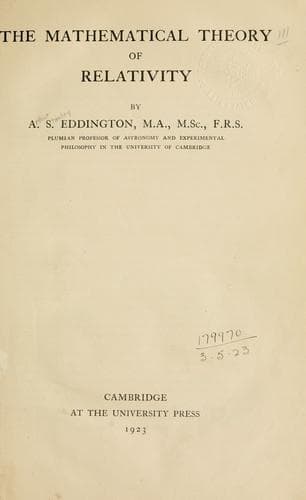
The Mathematical Theory of RelativityEddington, Arthur Stanley, Sir
Science
The Mathematical Theory of Relativity
Eddington, Arthur Stanley, Sir
Relativity (Physics)
The following paradox is sometimes found puzzling. Take coordinates for
an observer~$A$ at rest at the origin, and let $B$~be at rest at the time~$t$ at a
considerable distance from the origin. The vibrations of an atom at~$B$ are
slower (as measured in the time~$t$) than those of an atom at~$A$, and since the
coordinate-system is static this difference will be detected experimentally by
\emph{any} observer who measures the frequency of the light he receives. Accordingly
$B$~must detect the difference, and conclude that the light from~$A$ is displaced
towards the violet relatively to his standard atom. This is absurd since, if we
choose $B$ as origin, the light from~$A$ should be displaced towards the red. The
fallacy lies in ignoring what has happened during the long time of propagation
from~$A$ to~$B$ or $B$ to~$A$; during this time the two observers have ceased
to be in relative rest, so that compensating Doppler effects are superposed.
To obtain a clearer geometrical idea of de~Sitter's world, we consider only
one dimension of space, neglecting the coordinates$\theta$ and~$\phi$. Then by~\Eq{(67.31)}
\begin{align*}
-ds^{2} &= R^{2} (d\omega^{2} + \sin^{2}\omega\, d\zeta^{2})
= R^{2} (d\chi^{2} - \cos^{2}\chi\, dt^{2}) \\
&= dx^{2} + dy^{2} + dz^{2},
\end{align*}
\PageSep{165}
where
\begin{alignat*}{2}
x &= R\sin\omega \cos\zeta &&= R\cos\chi \sin it, \\
y &= R\sin\omega \sin\zeta &&= R\sin\chi, \\
z &= R\cos\omega &&= R\cos\chi \cos it,
\end{alignat*}
and
\[
x^{2} + y^{2} + z^{2} = R^{2}.
\]
It will be seen that real values of $\chi$ and~$t$ correspond to imaginary
values of~$\omega$ and~$\zeta$ and accordingly for real events $x$~is imaginary and $y$~and
$z$ are real. Introducing a real coordinate $\xi = -ix$, real space-time will be
represented by the hyperboloid of one sheet with its axis along the axis of~$\xi$,
\[
y^{2} + z^{2} - \xi^{2} = R^{2},
\]
the geometry being of the Galilean type
\[
ds^{2} = d\xi^{2} - dy^{2} - dz^{2}.
\]
We have
\begin{gather*}
r = R\sin\chi = y, \\
\tanh t = -i\tan it = -ix/z = \xi/z,
\end{gather*}
so that the space-partitions are made by planes perpendicular to the axis of~$y$,
and the time-partitions by planes through the axis of~$y$ cutting the hyperboloid
into lunes.
The light-tracks, $ds = 0$, are the generators of the hyperboloid. The tracks
of undisturbed particles are (non-Euclidean) geodesics on the hyperboloid;
and, except for $y = 0$, the space-partitions will not be geodesics, so that
particles do not remain at rest.
Public-domain text, read in full here on John Shaqi.
Reviews
Reviews
No reviews yet
Be the first to share your thoughts on this work.
Elsewhere in the archive
Join the Discussion
Join the discussion
Sign in to leave a comment or review.
Sign InorCreate an account