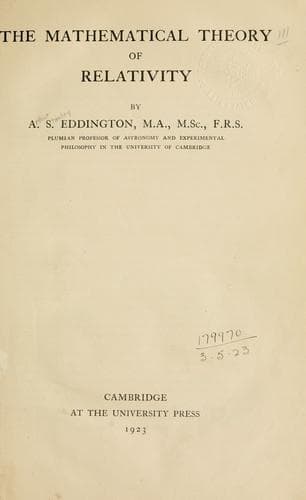
The Mathematical Theory of RelativityEddington, Arthur Stanley, Sir
Science
The Mathematical Theory of Relativity
Eddington, Arthur Stanley, Sir
Relativity (Physics)
But the suggestion is perhaps more plausible if we look at the inverse
relation, viz.\ $M$~as a function of~$\lambda$. If we can imagine the gradual destruction
of matter in the world (e.g.\ by coalescence of positive and negative electrons),
we see by~\Eq{(71.1)} that the radius of space gradually contracts; but it is not
clear what is the fixed standard of length by which $R$~is supposed to be
measured. The natural standard of length in a theoretical discussion is the
radius $R$ itself. Choosing it as unit, we have $M = \frac{1}{2}\pi$, whatever the number
of elementary particles in the world. Thus with this unit the mass of a particle
must be inversely proportional to the number of particles. Now the gravitational
mass is the radius of a sphere which has some intimate relation to
the structure of the particle; and we must conclude that as the destruction
of particles proceeds, this sphere must swell up as though some pressure were
being relaxed. We might try to represent this pressure by the gravitational
flux (\SecRef{63}) which proceeds from every particle; but I doubt whether that
leads to a satisfactory solution. However that may be, the idea that the
particles each endeavour to monopolise all space, and restrain one another by
a mutual pressure, seems to be the simplest interpretation of~\Eq{(71.1)} if it is to
be accepted.
We do not know whether the actual (or electrical) radius of the particle
would swell in the same proportion---by a rough guess I should anticipate
that it would depend on the square root of the above ratio. But this radius,
on which the scale of ordinary material standards depends, has nothing to do
with equation~\Eq{(71.1)}; and if we suppose that it remains constant, the argument
of \SecRef{66} need not be affected.
Public-domain text, read in full here on John Shaqi.
Reviews
Reviews
No reviews yet
Be the first to share your thoughts on this work.
Elsewhere in the archive
Join the Discussion
Join the discussion
Sign in to leave a comment or review.
Sign InorCreate an account