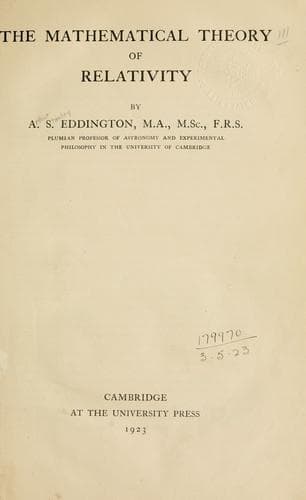
The Mathematical Theory of RelativityEddington, Arthur Stanley, Sir
Science
The Mathematical Theory of Relativity
Eddington, Arthur Stanley, Sir
Relativity (Physics)
In favour of Einstein's hypothesis is the fact that among the constants of
\index{Number of electrons in the world}%
nature there is one which is a very large pure number; this is typified by the
ratio of the radius of an electron to its gravitational mass $= 3 · 10^{42}$. It is difficult
to account for the occurrence of a pure number (of order greatly different
from unity) in the scheme of things; but this difficulty would be removed if
we could connect it with the number of particles in the world---a number
presumably decided by pure accident\footnotemark.\footnotetext
{The square of $3 · 10^{42}$ might well be of the same order as the total number of positive and
negative electrons. The corresponding radius is $10^{14}$~parsecs. But the result is considerably
altered if we take the proton instead of the electron as the more fundamental structure.}
There is an attractiveness in the
idea that the total number of the particles may play a part in determining
the constants of the laws of nature; we can more readily admit that the laws
of the actual world are specialised by the accidental circumstance of a particular
number of particles occurring in it, than that they are specialised by
the same number occurring as a mysterious ratio in the fine-grained structure
of the continuum.
In Einstein's world one direction is uncurved and this gives a kind of
absolute time. Our critic who has been waiting ever since \SecRef{1} with his blank
label ``true time'' will no doubt seize this opportunity of affixing it. Moreover
\PageSep{168}
absolute velocity is to some extent restored, for there is by hypothesis a
frame of reference with respect to which material bodies on the average have
only small velocities. Matter is essential to the existence of a space-time
frame according to Einstein's view; and it is inevitable that the space-time
frame should become to some extent materialised, thereby losing some of the
valuable elusiveness of a purely aetherial frame. It has been suggested that
since the amount of matter necessary for Einstein's world greatly exceeds that
known to astronomers, most of it is spread uniformly through space and is
undetectable by its uniformity. This is dangerously like restoring a crudely
material aether---regulated, however, by the strict injunction that it must on
no account perform any useful function lest it upset the principle of relativity.
We may leave aside this suggestion, which creates unnecessary difficulties.
I think that the matter contemplated in Einstein's theory is ordinary stellar
matter. Owing to the irregularity of distribution of stars, the actual form of
space is not at all a smooth sphere, and the formulae are only intended to give
an approximation to the general shape.
Public-domain text, read in full here on John Shaqi.
Reviews
Reviews
No reviews yet
Be the first to share your thoughts on this work.
Elsewhere in the archive
Join the Discussion
Join the discussion
Sign in to leave a comment or review.
Sign InorCreate an account