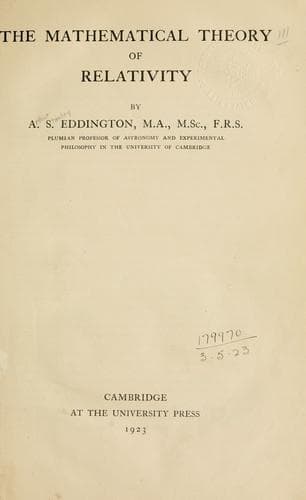
The Mathematical Theory of RelativityEddington, Arthur Stanley, Sir
Science
The Mathematical Theory of Relativity
Eddington, Arthur Stanley, Sir
Relativity (Physics)
We see that the pressure vanishes at $r = a$, and would become negative if
we attempted to continue the solution beyond $r = a$. Hence the sphere $r = a$
gives the boundary of the fluid. If it is desired to continue the solution outside
the sphere, another form of~$ds^{2}$ must be taken corresponding to the
equations for empty space.
Unless $a > \Chg{\surd(8/9\alpha)}{\sqrt{8/9\alpha}}$ the pressure will everywhere be finite. This condition
sets an upper limit to the possible size of a fluid sphere of given density. The
limit exists because the presence of dense matter increases the curvature of
space, and makes the total volume of space smaller. Clearly the volume of the
material sphere cannot be larger than the volume of space.
\PageSep{170}
For spheres which are not unduly large (e.g.\ not much larger than the
stars) this solution corresponds approximately to the problem of the equilibrium
of an incompressible fluid. The necessary conditions are satisfied, viz.\
(1) The density is uniform.
(2) The pressure is zero at the surface.
(3) The stress-system is an isotropic hydrostatic pressure, and therefore
satisfies the conditions of a perfect fluid.
(4) The pressure is nowhere infinite, negative, or imaginary.
Further equation~\Eq{(72.4)} determines the pressure at any distance from the
centre.
But the problem is only solved approximately, and the material here discussed
is not strictly incompressible nor is it a perfect fluid. The values of
$T_{1}^{1}$, $T_{2}^{2}$, $T_{3}^{3}$, $T_{4}^{4}$ refer to the particular coordinates used; these are arbitrary
and do not correspond to natural measure. So long as the sphere is small, the
difference does not amount to much; but for large spheres the solution ceases
to correspond to a problem of any physical importance since it does not refer
to natural measure. It is unfortunate that the solution breaks down for large
spheres, because the existence of a limit to the size of the sphere is one of the
most interesting objects of the research.
Clearly we need a solution in which the density referred to natural measure
is constant throughout; i.e.\ $T$~constant, instead of $T_{4}^{4}$~constant. The condition
for a perfect fluid also needs modification. (But it would be of considerable
interest to find the solution for a solid capable of supporting non-isotropic
stress, if the problem of the fluid proves too difficult.) So far as I know, no
progress has been made with the exact solution of this problem. It would
throw interesting light on the manner in which the radius of space contracts
as the size of the sphere continually increases.
Public-domain text, read in full here on John Shaqi.
Reviews
Reviews
No reviews yet
Be the first to share your thoughts on this work.
Elsewhere in the archive
Join the Discussion
Join the discussion
Sign in to leave a comment or review.
Sign InorCreate an account