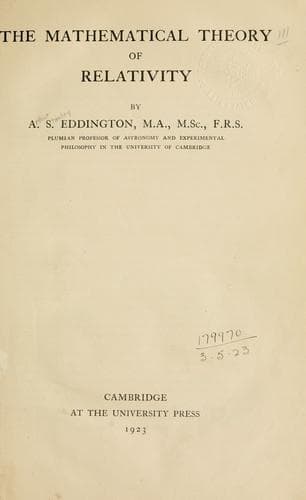
The Mathematical Theory of RelativityEddington, Arthur Stanley, Sir
Science
The Mathematical Theory of Relativity
Eddington, Arthur Stanley, Sir
Relativity (Physics)
The problem of determining~$ds^{2}$ at points within a sphere of fluid of uniform
\PageSep{169}
density has been treated by Schwarzschild, Nordström and de~Donder.
Schwarzschild's solution\footnote
{Schwarzschild's solution is of considerable interest; but I do not think that he solved exactly
the problem which he intended to solve, viz.\ that of an incompressible fluid. For that reason I do
not give the arguments which led to the solution, but content myself with discussing what distribution
of matter his solution represents. A full account is given by de~Donder, \Title{La Gravifique
Einsteinienne}, p.~169 (Gauthier-Villars, 1921). The original gravitational equations are used, the
natural curvature of space being considered negligible compared with that superposed by the
material sphere.}
is
\[
ds^{2} = -e^{\lambda}\, dr^{2} - r^{2}\, d\theta^{2} - r^{2}\sin^{2}\theta\, d\phi^{2} + e^{\nu}\, dt^{2},
\]
where
\[
\left.
\begin{aligned}
e^{\lambda} &= 1/(1 - \alpha r^{2})\Add{,} \\
e^{\nu} &= \tfrac{1}{4}\bigl(\Chg{3\surd(1 - \alpha a^{2})}{3\sqrt{1 - \alpha a^{2}}}
- \Chg{\surd(1 - \alpha r^{2})}{\sqrt{1 - \alpha r^{2}}}\bigr)^{2},
\end{aligned}
\right\}
\Tag{(72.1)}
\]
and $a$ and~$\alpha$ are constants.
The formulae~\Eq{(46.9)}, which apply to this form of~$ds$, become on raising one
suffix
\[
\left.
\begin{aligned}
-8\pi T_{1}^{1} &= e^{-\lambda} \bigl(\nu'/r - (e^{\lambda} - 1)/r^{2}\bigr)\Add{,} \\
-8\pi T_{2}^{2} &= e^{-\lambda} \bigl(\tfrac{1}{2} \nu'' - \tfrac{1}{4}\lambda'\nu' + \tfrac{1}{4}\nu'^{2} + \tfrac{1}{2}(\nu' - \lambda')/r\bigr)\Add{,} \\
-8\pi T_{3}^{3} &= -8\pi T_{2}^{2}\Add{,} \\
-8\pi T_{4}^{4} &= e^{-\lambda} \bigl(-\lambda'/r - (e^{\lambda} - 1)/r^{2}\bigr).
\end{aligned}
\right\}
\Tag{(72.2)}
\]
We find from~\Eq{(72.1)} that
\[
(e^{\lambda} - 1)/r^{2} = \tfrac{1}{2}\lambda'/r;\quad
\tfrac{1}{2} \nu'' - \tfrac{1}{4}\lambda'\nu' + \tfrac{1}{4}\nu'^{2} = \tfrac{1}{2}\nu'/r.
\]
Hence
\begin{gather*}
T_{1}^{1} = T_{2}^{2} = T_{3}^{3} = \frac{1}{8\pi} e^{\lambda}(\tfrac{1}{2}\lambda' - \nu')/r,
\Tag{(72.31)} \\
T_{4}^{4} = \frac{1}{8\pi} e^{\lambda} · \tfrac{3}{2}\lambda'/r
= 3\alpha/8\pi.
\Tag{(72.32)}
\end{gather*}
Referred to the coordinate-system $(r, \theta, \phi)$, $T_{4}^{4}$~represents the density and
$T_{1}^{1}$, $T_{2}^{2}$, $T_{3}^{3}$ the stress-system. Hence Schwarzschild's solution gives uniform
density and isotropic hydrostatic pressure at every point.
\index{Pressure!in homogeneous sphere}%
On further working out~\Eq{(72.31)}, we find that the pressure is
\[
p = -T_{1}^{1}
= \frac{\alpha}{8\pi}\,
\frac{\bigl\{\frac{3}{2}(1 - \alpha r^{2})^{\frac{1}{2}} - \frac{3}{2}(1 - \alpha a^{2})^{\frac{1}{2}}\bigr\}}
{\bigl\{\frac{3}{2}(1 - \alpha a^{2})^{\frac{1}{2}} - \frac{1}{2}(1 - \alpha r^{2})^{\frac{1}{2}}\bigr\}}.
\Tag{(72.4)}
\]
Public-domain text, read in full here on John Shaqi.
Reviews
Reviews
No reviews yet
Be the first to share your thoughts on this work.
Elsewhere in the archive
Join the Discussion
Join the discussion
Sign in to leave a comment or review.
Sign InorCreate an account