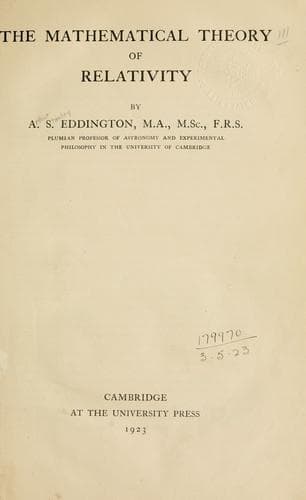
The Mathematical Theory of RelativityEddington, Arthur Stanley, Sir
Science
The Mathematical Theory of Relativity
Eddington, Arthur Stanley, Sir
Relativity (Physics)
It will be seen by reference to \Eq{(73.41)} and~\Eq{(73.42)} that Maxwell's equations
are equivalent to
\begin{gather*}
\frac{\dd F_{\mu\nu}}{\dd x_{\sigma}} +
\frac{\dd F_{\nu\sigma}}{\dd x_{\mu}} +
\frac{\dd F_{\sigma\mu}}{\dd x_{\nu}} = 0,
\Tag{(73.71)}\displaybreak[0] \\
\frac{\dd F^{\mu\nu}}{\dd x_{\nu}} = J^{\mu}.
\Tag{(73.72)}
\end{gather*}
The first comprises the four equations \Eq{(73.61)} and~\Eq{(73.64)}; and the second
comprises \Eq{(73.62)} and~\Eq{(73.63)}.
\PageSep{173}
On substituting $F_{\mu\nu} = \dd\kappa_{\mu}/\dd x_{\nu} - \dd\kappa_{\nu}\dd x_{\mu}$ in~\Eq{(73.71)} it will be seen that the
equation is satisfied identically. Also \Eq{(73.72)}~is the simplified form for Galilean
coordinates of $(F^{\mu\nu})_{\nu} = J^{\mu}$. Hence Maxwell's laws reduce to the simple form
\begin{align*}
F_{\mu\nu} &= \frac{\dd\kappa_{\mu}}{\dd x_{\nu}} - \frac{\dd\kappa_{\nu}}{\dd x_{\mu}},
\Tag{(73.73)} \\
F_{\nu}^{\mu\nu} &= J^{\mu},
\Tag{(73.74)}
\end{align*}
which are \emph{tensor equations}.
By~\Eq{(51.52)} the second equation becomes
\[
\frac{\dd\mf{F}^{\mu\nu}}{\dd x_{\nu}} = \mf{J}^{\mu}.
\Tag{(73.75)}
\]
Owing to the antisymmetry of~$\mf{F}^{\mu\nu}$, $\dd^{2}\mf{F}^{\mu\nu}/\dd x_{\mu}\, \dd x_{\nu}$ vanishes, the terms in the
summation cancelling in pairs. Hence
\[
\frac{\dd^{2}\mf{F}^{\mu\nu}}{\dd x_{\mu}\, \dd x_{\nu}}
= \frac{\dd\mf{J}^{\mu}}{\dd x_{\mu}} = 0,
\Tag{(73.76)}
\]
whence, by~\Eq{(51.12)},
\[
(J^{\mu})_{\mu} = 0.
\Tag{(73.77)}
\]
The divergence of the charge-and-current vector vanishes.
\index{Charge, electric, conservation of}%
\index{Electric charge!conservation of}%
For our original coordinates \Eq{(73.77)}~becomes
\[
\frac{\dd\sigma_{x}}{\dd x}
+ \frac{\dd\sigma_{y}}{\dd y}
+ \frac{\dd\sigma_{z}}{\dd z}
+ \frac{\dd\rho}{\dd t} = 0.
\Tag{(73.78)}
\]
If the current is produced by the motion of the charge with velocity $(u, v, w)$,
we have $\sigma_{x}, \sigma_{y}, \sigma_{z} = \rho u, \rho v, \rho w$, so that
\[
\frac{\dd(\rho u)}{\dd x}
+ \frac{\dd(\rho v)}{\dd y}
+ \frac{\dd(\rho w)}{\dd z}
+ \frac{\dd\rho}{\dd t} = 0,
\]
which is the usual equation of continuity (cf.~\Eq{(53.71)}), showing that electric
\index{Continuity, equation of!in electric flow}%
charge is conserved.
Public-domain text, read in full here on John Shaqi.
Reviews
Reviews
No reviews yet
Be the first to share your thoughts on this work.
Elsewhere in the archive
Join the Discussion
Join the discussion
Sign in to leave a comment or review.
Sign InorCreate an account