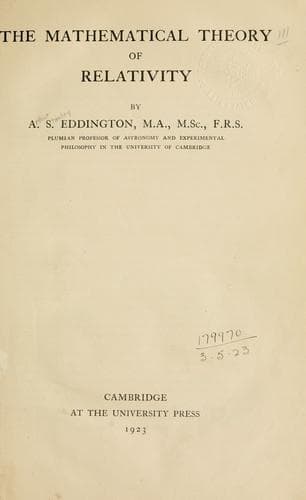
The Mathematical Theory of RelativityEddington, Arthur Stanley, Sir
Science
The Mathematical Theory of Relativity
Eddington, Arthur Stanley, Sir
Relativity (Physics)
It may be noted that even in non-Galilean coordinates the charge-and-current
vector satisfies the strict law of conservation
\index{Conservation!of electric charge}%
\[
\frac{\dd\mf{J}^{\mu}}{\dd x_{\mu}} = 0.
\]
This may be contrasted with the material energy and momentum which, it will
be remembered, do not in the general case satisfy
\[
\frac{\dd\mf{T}_{\mu}^{\nu}}{\dd x_{\nu}} = 0,
\]
so that it becomes necessary to supplement them by the pseudo-energy-tensor~$\mf{t}_{\mu}^{\nu}$
(\SecRef{59}) in order to maintain the formal law. Both $T^{\mu\nu}$ and~$J^{\mu}$ have the
property which in the relativity theory we recognise as the natural generalisation
of conservation, viz.\ $T_{\nu}^{\mu\nu} = 0$, $J_{\mu}^{\nu} = 0$.
If the charge is moving with velocity
\[
\frac{dx}{dt},\
\frac{dy}{dt},\
\frac{dz}{dt},
\]
\PageSep{174}
we have
\begin{align*}
J^{\mu}
&= \rho\, \frac{dx}{dt}, \rho\, \frac{dy}{dt}, \rho\, \frac{dz}{dt}, \rho \\
&= \rho\, \frac{ds}{dt}\left(\frac{dx}{ds}, \frac{dy}{ds}, \frac{dz}{ds}, \frac{dt}{ds}\right).
\Tag{(73.81)}
\end{align*}
The bracket constitutes a contravariant vector; consequently $\rho\, ds/dt$~is an
invariant. Now $ds/dt$~represents the FitzGerald contraction, so that a volume
which would be measured as unity by an observer moving with the charge
\index{Charge, electric, conservation of!invariance of}%
\index{Electric charge!invariance of}%
will be measured as~$ds/dt$ by an observer at rest in the coordinates chosen.
The invariant $\rho\, ds/dt$ is the amount of charge in this volume, i.e.\ unit proper-volume.
We write
\[
\rho_{0} = \rho\, \frac{ds}{dt},
\]
so that $\rho_{0}$~is the proper-density of the charge. If $A^{\mu}$~is the velocity-vector
$dx_{\mu}/ds$ of the charge, then \Eq{(73.81)}~becomes
\[
J^{\mu} = \rho_{0} A^{\mu}.
\Tag{(73.82)}
\]
\emph{Charge, unlike mass, is not altered by motion relative to the observer.} This
follows from the foregoing result that the amount of charge in an absolutely
defined volume (unit proper-volume) is an invariant. The reason for this
difference of behaviour of charge and mass will be understood by reference to~\Eq{(53.2)}
where the FitzGerald factor $ds/dt$ occurs squared.
Public-domain text, read in full here on John Shaqi.
Reviews
Reviews
No reviews yet
Be the first to share your thoughts on this work.
Elsewhere in the archive
Join the Discussion
Join the discussion
Sign in to leave a comment or review.
Sign InorCreate an account