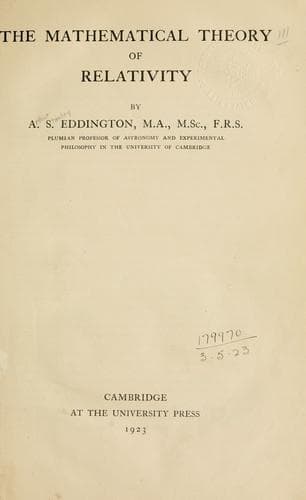
The Mathematical Theory of RelativityEddington, Arthur Stanley, Sir
Science
The Mathematical Theory of Relativity
Eddington, Arthur Stanley, Sir
Relativity (Physics)
In empty space this becomes
\[
\Wave F_{\mu\nu} = 2B_{\mu\nu\alpha\epsilon} F^{\epsilon\alpha}
\Tag{(74.42)}
\]
for an infinite world. For a curved world undisturbed by attracting matter,
in which $G_{\mu}^{\epsilon} = \lambda g_{\mu}^{\epsilon}$, $B_{\mu\nu\alpha\epsilon} = \frac{1}{3}\lambda(g_{\mu\nu} g_{\alpha\epsilon} - g_{\mu\alpha} g_{\nu\epsilon})$, the result is
\[
(\Wave + \tfrac{4}{3}\lambda)F_{\mu\nu} = 0.
\Tag{(74.43)}
\]
It need not surprise us that the velocity of propagation of electromagnetic
potential and of electromagnetic force is not the same (cf.~\Eq{(74.33)} and~\Eq{(74.43)}).
The former is not physically important since it involves the arbitrary convention
$\kappa_{\alpha}^{\alpha} = 0$.
But the result~\Eq{(74.42)} is, I think, unexpected. It shows that the equations
of propagation of electromagnetic force involve the Riemann-Christoffel tensor;
and therefore this is not one of the phenomena for which the ordinary Galilean
equations can be immediately generalised by the principle of equivalence.
\PageSep{177}
This naturally makes us uneasy as to whether we have done right in adopting
the invariant equations of propagation of light ($ds = 0$, $\delta\int ds = 0$) as true in
all circumstances; but the investigation which follows is reassuring.
\Subsection[(c)]{Propagation of a wave-front.}
The conception of a ``ray'' of light in physical optics is by no means
elementary. Unless the wave-front is of infinite extent, the ray is an abstraction,
and to appreciate its meaning a full discussion of the phenomena of
interference fringes is necessary. We do not wish to enter on such a general
discussion here; and accordingly we shall not attempt to obtain the formulae
for the tracks of rays of light for the case of general coordinates \Foreign{ab initio}.
Our course will be to reduce the general formulae to such a form, that the
subsequent work will follow the ordinary treatment given in works on physical
optics.
Public-domain text, read in full here on John Shaqi.
Reviews
Reviews
No reviews yet
Be the first to share your thoughts on this work.
Elsewhere in the archive
Join the Discussion
Join the discussion
Sign in to leave a comment or review.
Sign InorCreate an account