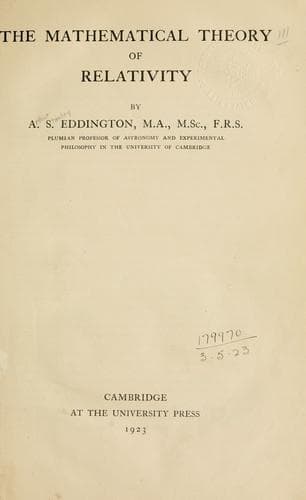
The Mathematical Theory of RelativityEddington, Arthur Stanley, Sir
Science
The Mathematical Theory of Relativity
Eddington, Arthur Stanley, Sir
Relativity (Physics)
The fundamental equation treated in the usual theory of electromagnetic
waves is
\[
\left(\frac{\dd^{2}}{\dd t^{2}}
- \frac{\dd^{2}}{\dd x^{2}}
- \frac{\dd^{2}}{\dd y^{2}}
- \frac{\dd^{2}}{\dd z^{2}}\right) \kappa_{\mu} = 0,
\Tag{(74.51)}
\]
which is the form taken by $\Wave\kappa_{\mu} = 0$ in Galilean coordinates. When the region
of space-time is not flat we cannot immediately simplify $\Wave\kappa_{\mu}$ in this way;
but we can make a considerable simplification by adopting natural coordinates
at the point considered. In that case the $3$-index symbols (but not their
derivatives) vanish, and
\begin{align*}
\Wave\kappa_{\mu} &= g^{\alpha\beta}(\kappa_{\mu})_{\alpha\beta} \\
&= g^{\alpha\beta} \left(\frac{\dd^{2}\kappa_{\mu}}{\dd x_{\alpha}\, \dd x_{\beta}}
- \frac{\dd}{\dd x_{\alpha}} \{\mu\beta, \epsilon\} · \kappa_{\epsilon}\right).
\end{align*}
Hence the law of propagation $\Wave\kappa_{\mu} = 0$ becomes in natural coordinates
\[
\left(\frac{\dd^{2}}{\dd t^{2}}
- \frac{\dd^{2}}{\dd x^{2}}
- \frac{\dd^{2}}{\dd y^{2}}
- \frac{\dd^{2}}{\dd z^{2}}\right) \kappa_{\mu}
= g^{\alpha\beta}\, \frac{\dd}{\dd x_{\alpha}} \{\mu\beta, \epsilon\} · \kappa_{\epsilon}.
\Tag{(74.52)}
\]
At first sight this does not look very promising for a justification of the
principle of equivalence. We cannot make all the derivatives $\dd\{\mu\beta, \epsilon\}/\dd x_{\alpha}$
vanish by any choice of coordinates, since these determine the Riemann-Christoffel
tensor. It looks as though the law of propagation in curved space-time
involves the Riemann-Christoffel tensor, and consequently differs from
the law in flat space-time. But the inner multiplication by~$g^{\alpha\beta}$ saves the
situation. It is possible to choose coordinates such that $g^{\alpha\beta}\, \dd\{\mu\beta, \epsilon\}/\dd x_{\alpha}$ vanishes
for all the sixteen possible combinations of $\mu$ and~$\epsilon$\footnotemark.\footnotetext
{According to~\Eq{(36.55)} it is possible by a transformation to increase $\dd\{\mu\beta, \epsilon\}/\dd x_{\alpha}$ by an
arbitrary quantity~$a_{\mu\beta\alpha}^{\epsilon}$, symmetrical in $\mu$,~$\beta$ and~$\alpha$. The sixteen quantities $g^{\alpha\beta} a_{\mu\beta\alpha}^{\epsilon}$ ($\mu, \epsilon = 1, 2, 3, 4$)
will not have to fulfil any conditions of symmetry, and may be chosen independently of one another
Hence we can make the right-hand side of~\Eq{(74.52)} vanish by an appropriate transformation.}
For these coordinates
\Eq{(74.52)}~reduces to~\Eq{(74.51)}, and the usual solution for flat space-time will
apply at the point considered.
\PageSep{178}
Public-domain text, read in full here on John Shaqi.
Reviews
Reviews
No reviews yet
Be the first to share your thoughts on this work.
Elsewhere in the archive
Join the Discussion
Join the discussion
Sign in to leave a comment or review.
Sign InorCreate an account