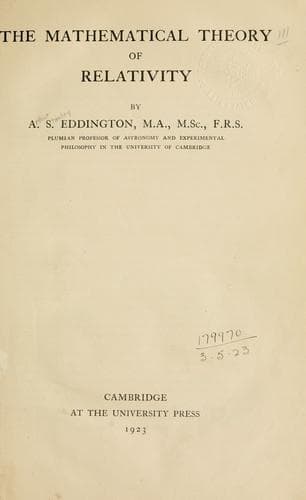
The Mathematical Theory of RelativityEddington, Arthur Stanley, Sir
Science
The Mathematical Theory of Relativity
Eddington, Arthur Stanley, Sir
Relativity (Physics)
\Section[Lorentz transformation of electromagnetic force]{75.}{The Lorentz transformation of electromagnetic force}
\index{Force!Lorentz transformation of}%
\index{Lorentz transformation!for electromagnetic force}%
The Lorentz transformation for an observer~$S'$ moving relatively to~$S$ with
a velocity~$u$ along the $x$-axis is
\[
x_{1}' = q(x_{1} - ux_{4}),\quad
x_{2}' = x_{2},\quad
x_{3}' = x_{3},\quad
x_{4}' = q(x_{4} - ux_{1}),
\Tag{(75.1)}
\]
where
\[
q = (1 - u^{2})^{-\frac{1}{2}}.
\]
\PageSep{180}
We use $q$ instead of~$\beta$ in order to avoid confusion with the component~$\beta$ of
magnetic force.
\index{Force!mechanical force due to}%
\index{Mechanical force of electromagnetic field}%
We have
\[
\frac{\dd x_{1}'}{\dd x_{1}} = \frac{\dd x_{4}'}{\dd x_{4}} = q,\quad
\frac{\dd x_{1}'}{\dd x_{4}} = \frac{\dd x_{4}'}{\dd x_{1}} = -qu,\quad
\frac{\dd x_{2}'}{\dd x_{2}} = \frac{\dd x_{3}'}{\dd x_{3}} = 1,
\Tag{(75.2)}
\]
and all other derivatives vanish.
To calculate the electromagnetic force for~$S'$ in terms of the force for~$S$,
we apply the general formulae of transformation~\Eq{(23.21)}. Thus
\begin{align*}
\gamma' = F'^{12}
&= \frac{\dd x_{1}'}{\dd x_{\alpha}}\, \frac{\dd x_{2}'}{\dd x_{\beta}}\, F^{\alpha\beta} \\
&= \frac{\dd x_{1}'}{\dd x_{1}}\, \frac{\dd x_{2}'}{\dd x_{2}}\, F^{12}
+ \frac{\dd x_{1}'}{\dd x_{4}}\, \frac{\dd x_{2}'}{\dd x_{2}}\, F^{42} \\
&= q\gamma - quY.
\end{align*}
Working out the other components similarly, the result is
\[
\left.
\begin{aligned}
X' &= X, & Y' &= q(Y - u\gamma), & Z' &= q(Z + u\beta)\Add{,} \\
\alpha' &= \alpha, & \beta' &= q(\beta + uZ), & \gamma' &= q(\gamma - uY),
\end{aligned}
\right\}
\Tag{(75.3)}
\]
which are the formulae given by Lorentz.
The more general formulae when the velocity of the observer~$S'$ is $(u, v, w)$
become very complicated. We shall only consider the approximate results
when the square of the velocity is neglected. In that case $q = 1$, and the
formulae~\Eq{(75.3)} can be completed by symmetry, viz.\
\[
\left.
\begin{alignedat}{3}
X' &= X &&- w\beta &&+ v\gamma\Add{,} \\
\alpha' &= \alpha &&+ wY &&- vZ.
\end{alignedat}
\right\}
\Tag{(75.4)}
\]
\Section{76.}{Mechanical effects of the electromagnetic field}
According to the elementary laws, a piece of matter carrying electric
charge of density~$\rho$ experiences in an electrostatic field a mechanical force
\[
\rho X,\quad \rho Y,\quad \rho Z
\]
per unit volume. Moving charges constituting electric currents of amount
$(\sigma_{x}, \sigma_{y}, \sigma_{z})$ per unit volume are acted on by a magnetic field, so that a
mechanical force
\[
\gamma\sigma_{y} - \beta\sigma_{z},\quad
\alpha\sigma_{z} - \gamma\sigma_{x},\quad
\beta\sigma_{x} - \alpha\sigma_{y}
\]
per unit volume is experienced.
Public-domain text, read in full here on John Shaqi.
Reviews
Reviews
No reviews yet
Be the first to share your thoughts on this work.
Elsewhere in the archive
Join the Discussion
Join the discussion
Sign in to leave a comment or review.
Sign InorCreate an account