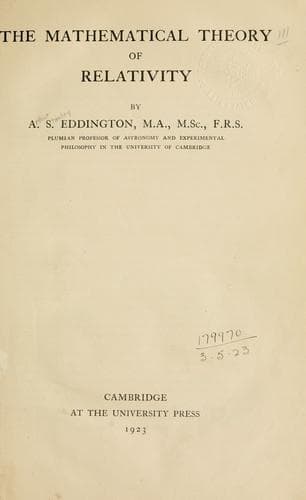
The Mathematical Theory of RelativityEddington, Arthur Stanley, Sir
Science
The Mathematical Theory of Relativity
Eddington, Arthur Stanley, Sir
Relativity (Physics)
For an infinitesimal element we may take $\rho$~constant and insert limits of
integration; but these limits must be taken for the time~$t - r$, and this introduces
an important factor representing a kind of Doppler effect. If the element
of charge is bounded by two planes perpendicular to the direction of~$r$, the
limits of integration are from the front plane at time $t - r$ to the rear plane
\PageSep{179}
\index{Retarded potential}%
at time $t - r - dr$. If $v_{r}$~is the component velocity in the direction of~$r$, the
front plane has had time to advance a distance~$v_{r}\, dr$. Consequently the
instantaneous thickness of the element of charge is less than the distance
between the limits of integration in the ratio $1 - v_{r}$; and the integration is
over a volume $(1 - v_{r})^{-1}$~times the instantaneous volume of the element of
charge. Hence
\[
\iiint \rho\, d\xi\, d\eta\, d\zeta = \frac{de}{1 - v_{r}}.
\]
Writing as usual $\beta$~for the FitzGerald factor~$dt/ds$, \Eq{(74.62)}~becomes
\[
\kappa^{\mu} = \left\{\frac{A^{\mu}\, de}{4\pi r\beta(1 - v_{r})}\right\}_{t-r}
= \left\{\frac{de(u, v, w, 1)}{4\pi r(1 - v_{r})}\right\}_{t-r}.
\Tag{(74.71)}
\]
In most applications the motion of the charge can be regarded as uniform
during the time of propagation of the potential through the distance~$r$. In
that case
\[
\{r(1 - v_{r})\}_{t-r} = \{r\}_{t},
\]
the present distance being less than the antedated distance by~$v_{r} r$. The result
then becomes
\[
\kappa^{\mu} = \left\{\frac{A^{\mu}\, de}{4\pi r\beta}\right\}_{t}
= \left\{\frac{de(u, v, w, 1)}{4\pi r}\right\}_{t}.
\Tag{(74.72)}
\]
It will be seen that the scalar potential~$\Phi$ of a charge is unaltered by
uniform motion, and must be reckoned for the present position of the charge,
\emph{not from the antedated position}.
The equation~\Eq{(74.71)} can be written in the pseudo-tensor form
\[
\kappa^{\mu} = \left\{\frac{A^{\mu}\, de}{4\pi A^{\nu}R_{\nu}}\right\}_{R^{\alpha}R_{\alpha}=0},
\Tag{(74.8)}
\]
where $R^{\mu}$~is the pseudo-vector representing the displacement from the charge
\index{Pseudo-vector}%
$(\xi, \eta, \zeta, \tau)$ to the point $(x, y, z, t)$ where $\kappa^{\mu}$~is reckoned. The condition
$R^{\alpha}R_{\alpha} = 0$ gives
\[
-(x - \xi)^{2} - (y - \eta)^{2} - (z - \zeta)^{2} + (t - \tau)^{2} = 0,
\]
so that
\[
\tau = t - r.
\]
Also
\begin{align*}
A^{\nu} R_{\nu}
&= -\beta u(x - \xi) - \beta v(y - \eta) - \beta w(z - \zeta) + \beta(t - \tau) \\
&= -\beta v_{r} r + \beta r \\
&= r\beta(1 - v_{r}).
\end{align*}
A \emph{finite} displacement~$R^{\mu}$ is not a vector in the general theory. We call it
a pseudo-vector because it behaves as a vector for Galilean coordinates and
Lorentz transformations. Thus the equation~\Eq{(74.8)} does not admit of application
to coordinates other than Galilean.
Public-domain text, read in full here on John Shaqi.
Reviews
Reviews
No reviews yet
Be the first to share your thoughts on this work.
Elsewhere in the archive
Join the Discussion
Join the discussion
Sign in to leave a comment or review.
Sign InorCreate an account