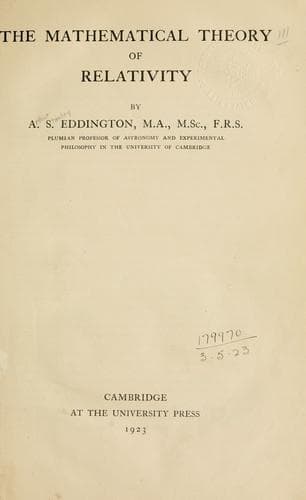
The Mathematical Theory of RelativityEddington, Arthur Stanley, Sir
Science
The Mathematical Theory of Relativity
Eddington, Arthur Stanley, Sir
Relativity (Physics)
Perhaps it might have been expected that with the advent of the electron
\index{Non-Maxwellian stresses}%
theory of matter it would become unnecessary to retain a separate material
energy-tensor~$M^{\mu\nu}$, and that the whole energy and momentum could be
included in the energy-tensor of the electromagnetic field. But we cannot
dispense with~$M^{\mu\nu}$. The fact is that an electron must not be regarded as a
purely electromagnetic phenomenon; that is to say, something enters into its
constitution which is not comprised in Maxwell's theory of the electromagnetic
field. In order to prevent the electronic charge from dispersing under its own
repulsion, non-Maxwellian ``binding forces'' are necessary, and it is the energy,
stress and momentum of these binding forces which constitute the material
energy-tensor~$M^{\mu\nu}$.
\Section{77.}{The electromagnetic energy-tensor}
\index{Electromagnetic action!energy-tensor}%
\index{Energy-tensor of matter!electromagnetic@of electromagnetic field}%
To determine explicitly the value of~$E_{\mu}^{\nu}$ we have to rely on the relation
found in the preceding section
\[
E_{\mu\nu}^{\nu} = h_{\mu} = F_{\mu\nu} J^{\nu} = F_{\mu\nu} F_{\sigma}^{\nu\sigma}.
\Tag{(77.1)}
\]
The solution of this differential equation is
\[
E_{\mu}^{\nu} = -F^{\nu\alpha} F_{\mu\alpha} + \tfrac{1}{4} g_{\mu}^{\nu} F^{\alpha\beta} F_{\alpha\beta}.
\Tag{(77.2)}
\]
To verify this we take the divergence, remembering that covariant differentiation
obeys the usual distributive law and that $g_{\mu}^{\nu}$~is a constant.
\begin{alignat*}{2}
E_{\mu\nu}^{\nu}
&= -F_{\nu}^{\nu\alpha} F_{\mu\alpha}
&&- \phantom{\tfrac{1}{2}} F^{\nu\alpha} F_{\mu\alpha\nu}
+ \tfrac{1}{4} g_{\mu}^{\nu}
(F_{\nu}^{\alpha\beta} F_{\alpha\beta} + F^{\alpha\beta} F_{\alpha\beta\nu}) \\
%
&= -F_{\nu}^{\nu\alpha} F_{\mu\alpha}
&&- \phantom{\tfrac{1}{2}} F^{\nu\alpha} F_{\mu\alpha\nu}
+ \tfrac{1}{2} g_{\mu}^{\nu} F^{\alpha\beta} F_{\alpha\beta\nu}
\qquad\text{by~\Eq{(26.3)}} \\
%
&= -F_{\nu}^{\nu\alpha} F_{\mu\alpha}
&&- \tfrac{1}{2} F^{\beta\alpha} F_{\mu\alpha\beta}
- \tfrac{1}{2} F^{\alpha\beta} F_{\mu\beta\alpha}
+ \tfrac{1}{2} F^{\alpha\beta} F_{\alpha\beta\mu} \\
\intertext{by changes of dummy suffixes,}
&= F_{\nu}^{\alpha\nu} F_{\mu\alpha}
&&+ \tfrac{1}{2} F^{\alpha\beta}(F_{\mu\alpha\beta} + F_{\beta\mu\alpha} + F_{\alpha\beta\mu})
\end{alignat*}
by the antisymmetry of~$F^{\mu\nu}$.
\PageSep{183}
It is easily verified that
\[
F_{\mu\alpha\beta} + F_{\beta\mu\alpha} + F_{\alpha\beta\mu}
= \frac{\dd F_{\mu\alpha}}{\dd x_{\beta}}
+ \frac{\dd F_{\beta\mu}}{\dd x_{\alpha}}
+ \frac{\dd F_{\alpha\beta}}{\dd x_{\mu}} = 0
\]
by \Eq{(30.3)} and~\Eq{(73.71)}; the terms containing the $3$-index symbols mutually
cancel.
Hence
\[
E_{\mu\nu}^{\nu} = F_{\nu}^{\alpha\nu} F_{\mu\alpha} = J^{\alpha} F_{\mu\alpha},
\]
agreeing with~\Eq{(77.1)}.
Public-domain text, read in full here on John Shaqi.
Reviews
Reviews
No reviews yet
Be the first to share your thoughts on this work.
Elsewhere in the archive
Join the Discussion
Join the discussion
Sign in to leave a comment or review.
Sign InorCreate an account