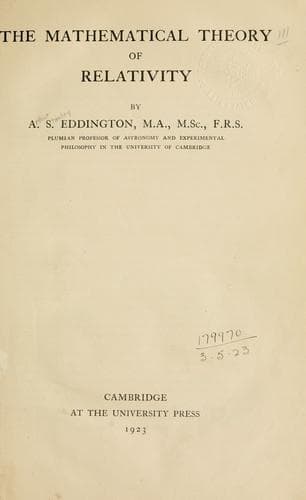
The Mathematical Theory of RelativityEddington, Arthur Stanley, Sir
Science
The Mathematical Theory of Relativity
Eddington, Arthur Stanley, Sir
Relativity (Physics)
It is of interest to work out the components of the energy-tensor \Eq{(77.2)}
\index{Stress-system!electromagnetic}%
in Galilean coordinates by \Eq{(73.41)} and~\Eq{(73.42)}. We have
\begin{align*}
&F^{\alpha\beta} F_{\alpha\beta}
= 2(\alpha^{2} + \beta^{2} + \gamma^{2} - X^{2} - Y^{2} - Z^{2}),
\Tag{(77.3)} \\
&E_{1}^{1} = \tfrac{1}{2}(\alpha^{2} - \beta^{2} - \gamma^{2})
+ \tfrac{1}{2}(X^{2} - Y^{2} - Z^{2}),
\Tag{(77.41)}\displaybreak[0] \\
&E_{1}^{2} = \alpha\beta + XY,
\Tag{(77.42)} \\
&E_{1}^{4} = \beta Z - \gamma Y,
\Tag{(77.43)}\displaybreak[0] \\
&E_{4}^{4} = \tfrac{1}{2}(\alpha^{2} + \beta^{2} + \gamma^{2})
+ \tfrac{1}{2}(X^{2} + Y^{2} + Z^{2}).
\Tag{(77.44)}
\end{align*}
The last gives the energy or mass of the electromagnetic field; the third
\index{Mass!invariant and relative}%
\index{Mass!of electromagnetic field}%
expression gives the momentum; the first two give the stresses in the field.
\index{Momentum!electromagnetic}%
In all cases these formulae agree with those of the classical theory.
Momentum, being rate of flow of mass, is also the rate of flow of energy.
In the latter aspect it is often called Poynting's vector. It is seen from~\Eq{(77.43)}
\index{Poynting's vector}%
that the momentum is the vector-product of the electric and magnetic forces---to
use the terminology of the elementary vector theory.
From $E_{\mu}^{\nu}$ we can form a scalar~$E$ by contraction, just as $T$~is formed from~$T_{\mu}^{\nu}$.
The invariant density~$T$ will be made up of the two parts $E$ and~$M$, the
former arising from the electromagnetic field and the latter from the matter
or non-Maxwellian stresses involved in the electron. It turns out, however,
\index{Electron!non-Maxwellian stresses in}%
that $E$~is identically zero, so that the electromagnetic field contributes nothing
to the invariant density. The invariant density must be attributed entirely
to the non-Maxwellian binding stresses. Contracting~\Eq{(77.2)}
\[
E = -F^{\mu\alpha} F_{\mu\alpha} + \tfrac{1}{4} g_{\mu}^{\mu} F^{\alpha\beta} F_{\alpha\beta} = 0,
\Tag{(77.5)}
\]
since $g_{\mu}^{\mu} = 4$.
Public-domain text, read in full here on John Shaqi.
Reviews
Reviews
No reviews yet
Be the first to share your thoughts on this work.
Elsewhere in the archive
Join the Discussion
Join the discussion
Sign in to leave a comment or review.
Sign InorCreate an account