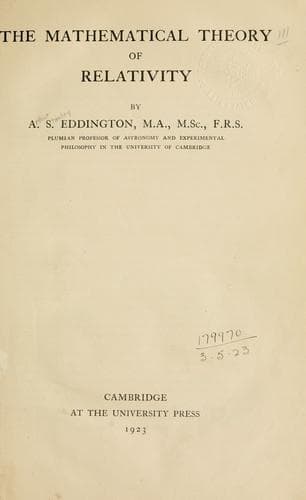
The Mathematical Theory of RelativityEddington, Arthur Stanley, Sir
Science
The Mathematical Theory of Relativity
Eddington, Arthur Stanley, Sir
Relativity (Physics)
It is usually assumed that the non-Maxwellian stresses are confined to
the interior, or the close proximity, of the electrons, and do not wander about
in the detached way that the Maxwellian stresses do, e.g.\ in light-waves.
I shall adopt this view in order not to deviate too widely from other writers,
although I do not see any particular reason for believing it to be true\footnotemark.\footnotetext
{We may evade the difficulty by extending the definition of electrons or matter to include all
regions where Maxwell's equations are inadequate (e.g.\ regions containing quanta).}
If then all non-Maxwellian stresses are closely bound to the electrons, it
follows that in regions containing no matter $E_{\mu}^{\nu}$~is the entire energy-tensor.
Then \Eq{(54.3)}~becomes
\[
G_{\mu}^{\nu} - \tfrac{1}{2} g_{\mu}^{\nu} G = -8\pi E_{\mu}^{\nu}.
\Tag{(77.6)}
\]
Contracting,
\[
G = 8\pi E = 0,
\]
and the equation simplifies to
\[
G_{\mu\nu} = -8\pi E_{\mu\nu}
\Tag{(77.7)}
\]
for regions containing electromagnetic fields but no matter. We may notice
that the Gaussian curvature of space-time is zero even when electromagnetic
energy is present provided there are no electrons in the region.
Since for electromagnetic energy the invariant mass,~$m$, is zero, and the
relative mass,~$M$, is finite, the equation~\Eq{(12.3)}
\[
M = m\, \Chg{dt/ds}{\frac{dt}{ds}}
\]
shows that $ds/dt$~is zero. Accordingly free electromagnetic energy must always
have the velocity of light.
\PageSep{185}
\Section{78.}{The gravitational field of an electron}
\index{Electron!gravitational field of}%
This problem differs from that of the gravitational field of a particle (\SecRef{38})
\index{Gravitational field of a particle!of an electron}%
in that the electric field spreads through all space, and consequently the
energy-tensor is not confined to a point or small sphere at the origin.
For the most general symmetrical field we take as before
\[
g_{11} = -e^{\lambda},\quad
g_{22} = -r^{2},\quad
g_{33} = -r^{2} \sin^{2}\theta,\quad
g_{44} = e^{\nu}.
\Tag{(78.1)}
\]
Since the electric field is static, we shall have
\[
F, G, H = \kappa_{1}, \kappa_{2}, \kappa_{3} = 0,
\]
and $\kappa_{4}$~will be a function of $r$~only. Hence the only surviving components of~$F_{\mu\nu}$
are
\[
F_{41} = -F_{14} = \kappa_{4}',
\Tag{(78.2)}
\]
the accent denoting differentiation with respect to~$r$. Then
\[
F^{41} = g^{44} g^{11} F_{41} = -e^{-(\lambda+\nu)} \kappa_{4}',
\]
and
\[
\mf{F}^{41} = F^{41} \sqrt{-g}
= -e^{-\frac{1}{2}(\lambda+\nu)} r^{2} \sin\theta · \kappa_{4}'.
\]
Hence by~\Eq{(73.75)} the condition for no electric charge and current (except at
the singularity at the origin) is
\[
\frac{\dd\mf{F}^{41}}{\dd x_{1}}
= -\sin\theta\, \frac{\dd}{\dd r}(e^{-\frac{1}{2}(\lambda+\nu)} r^{2}\kappa_{4}') = 0,
\Tag{(78.3)}
\]
so that
\[
\kappa_{4}' = \frac{\epsilon}{r^{2}}\, e^{\frac{1}{2}(\lambda+\nu)},
\Tag{(78.4)}
\]
where $\epsilon$~is a constant of integration.
Public-domain text, read in full here on John Shaqi.
Reviews
Reviews
No reviews yet
Be the first to share your thoughts on this work.
Elsewhere in the archive
Join the Discussion
Join the discussion
Sign in to leave a comment or review.
Sign InorCreate an account