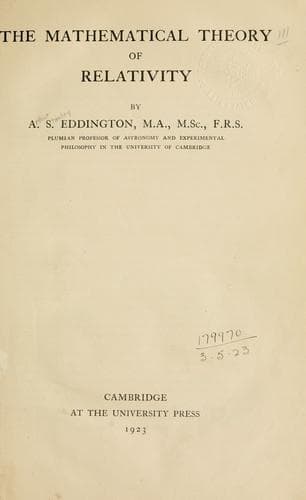
The Mathematical Theory of RelativityEddington, Arthur Stanley, Sir
Science
The Mathematical Theory of Relativity
Eddington, Arthur Stanley, Sir
Relativity (Physics)
Substituting in~\Eq{(77.2)} we find
\begin{align*}
E_{1}^{1}
= -E_{2}^{2}
= -E_{3}^{3}
= E_{4}^{4}
&= \tfrac{1}{2} e^{-\lambda-\nu} \kappa_{4}'^{2} \\
&= \frac{1}{2}\, \frac{\epsilon^{2}}{r^{4}}.
\Tag{(78.5)}
\end{align*}
By \Eq{(77.7)} we have to substitute $-8\pi E_{\mu\nu}$ for zero on the right-hand side of
(\EqNo{38.61}--\EqNo{38.64}). The first and fourth equations give as before $\lambda' = -\nu'$; and the
second equation now becomes
\begin{align*}
e^{\nu} (1 + r\nu') - 1
&= -8\pi g_{22} E_{2}^{2} \\
&= -4\pi \epsilon^{2}/r^{2}.
\end{align*}
Hence writing $e^{\nu} = \gamma$,
\[
\gamma + r\gamma' = 1 - 4\pi \epsilon^{2}/r^{2},
\]
so that
\[
r\gamma = r + 4\pi \epsilon^{2}/r - 2m,
\]
where $2m$~is a constant of integration.
Hence the gravitational field due to an electron is given by
\[
ds^{2} = -\gamma^{-1}\, dr^{2} - r^{2}\, d\theta^{2} - r^{2}\sin^{2}\theta\, d\phi^{2} + \gamma\, dt^{2},
\]
with
\[
\gamma = 1 - \frac{2m}{r} + \frac{4\pi\epsilon^{2}}{r^{2}}.
\Tag{(78.6)}
\]
This result appears to have been first given by Nordström. I have here
followed the solution as given by G.~B. Jeffery\footnotemark.\footnotetext
{\Title{Proc.\ Roy.\ Soc.}\ vol.~99\Vol{A}, p.~123.}
\PageSep{186}
The effect of the term $4\pi\epsilon^{2}/r^{2}$ is that the effective mass decreases as $r$~decreases.
This is what we should naturally expect because the mass or energy
is spread throughout space. We cannot put the constant~$m$ equal to zero,
because that would leave a \emph{repulsive} force on an uncharged particle varying
as the inverse cube of the distance; by \Eq{(55.8)} the approximate Newtonian
potential is $m/r - 2\pi\epsilon^{2}/r^{2}$.
The constant~$m$ can be identified with the mass and $4\pi\epsilon$ with the electric
charge of the particle. The known experimental values for the negative
electron are
\begin{align*}
m &= 7 · 10^{-56} \text{ cm.}, \\
a &= \frac{2\pi\epsilon^{2}}{m} = 1.5 · 10^{-13} \text{ cm.}
\end{align*}
The quantity~$a$ is usually considered to be of the order of magnitude of the
radius of the electron, so that at all points outside the electron $m/r$~is of order
$10^{-40}$ or smaller. Since $\lambda + \nu = 0$, \Eq{(78.4)}~becomes
\[
F_{41} = \kappa_{4}' = \frac{\epsilon}{r^{2}},
\]
which justifies our identification of~$4\pi\epsilon$ with the electric charge.
This example shows how very slight is the gravitational effect of the
electronic energy. We can discuss most electromagnetic problems without
taking account of the non-Euclidean character which an electromagnetic field
necessarily imparts to space-time, the deviations from Euclidean geometry
being usually so small as to be negligible in the cases we have to consider.
Public-domain text, read in full here on John Shaqi.
Reviews
Reviews
No reviews yet
Be the first to share your thoughts on this work.
Elsewhere in the archive
Join the Discussion
Join the discussion
Sign in to leave a comment or review.
Sign InorCreate an account