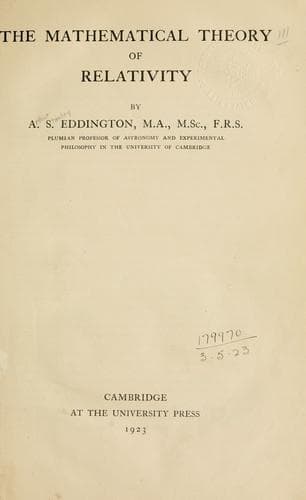
The Mathematical Theory of RelativityEddington, Arthur Stanley, Sir
Science
The Mathematical Theory of Relativity
Eddington, Arthur Stanley, Sir
Relativity (Physics)
When $r$~is diminished the value of~$\gamma$ given by~\Eq{(78.6)} decreases to a minimum
for $r = 2a$, and then increases continually becoming infinite at $r = 0$. There is
no singularity in the electromagnetic and gravitational fields except at $r = 0$.
It is thus possible to have an electron which is strictly a point-singularity,
but nevertheless has a finite mass and charge.
The solution for the gravitational field of an uncharged particle is quite
different in this respect. There is a singularity at $r = 2m$, so that the particle
must have a finite perimeter not less than~$4\pi m$. Moreover this singularity is
caused by $\gamma$~vanishing, whereas for the point-electron the singularity is due
\index{Point-electron}%
to $\gamma$~becoming infinite.
This demonstration that a point-electron may have exactly the properties
which electrons are observed to have is a useful corrective to the general belief
that the radius of an electron is known with \emph{certainty}. But on the whole,
I think that it is more likely that an electron is a structure of finite size; our
solution will then only be valid until we enter the substance of the electron,
so that the question of a singularity at the origin does not arise.
Assuming that we do not encounter the substance of the electron outside
the sphere $r = a$, the total energy of the electromagnetic field beyond this
radius would be equal to the mass of the electron determined by observation.
\PageSep{187}
For this reason $a$~is usually taken as the radius of the electron. If it is
admitted that the electromagnetic field continues undisturbed within this
limit, an excess of energy accumulates, and it is therefore necessary to suppose
that there exists negative energy in the inner portion, or that the effect of
the singularity is equivalent to a negative energy. The conception of negative
energy is not very welcome according to the usual outlook.
Another reason for believing that the charge of an electron is distributed
through a volume of radius roughly equal to~$a$ will be found in the investigation
of \SecRef{80}. Accordingly I am of opinion that the point-electron is no more
than a mathematical curiosity, and that the solution~\Eq{(78.6)} should be limited
to values of~$r$ greater than~$a$.
\Section{79.}{Electromagnetic action}
\index{Action, material or gravitational!electromagnetic}%
\index{Electromagnetic action}%
\index{Hamiltonian derivative!of electromagnetic action}%
Public-domain text, read in full here on John Shaqi.
Reviews
Reviews
No reviews yet
Be the first to share your thoughts on this work.
Elsewhere in the archive
Join the Discussion
Join the discussion
Sign in to leave a comment or review.
Sign InorCreate an account