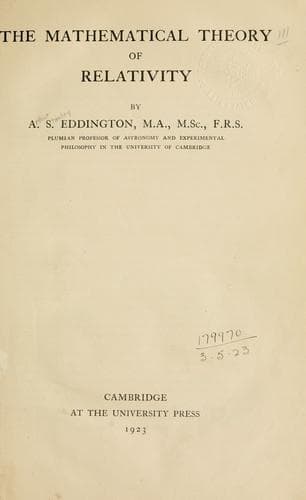
The Mathematical Theory of RelativityEddington, Arthur Stanley, Sir
Science
The Mathematical Theory of Relativity
Eddington, Arthur Stanley, Sir
Relativity (Physics)
\Section{80.}{Explanation of the mechanical force}
\index{Force!mechanical force due to}%
\index{Mechanical force of electromagnetic field!explanation of}%
Why does a charged particle move when it is placed in an electromagnetic
field? We may be tempted to reply that the reason is obvious; there is an
electric force lying in wait, and it is the nature of a force to make bodies
move. But this is a confusion of terminology; electric force is not a force in
the mechanical sense of the term; it has nothing to do with pushing and
pulling. Electric force describes a world-condition essentially different from
that described by a mechanical force or stress-system; and the discussion in
\SecRef{76} was based on empirical laws without theoretical explanation.
If we wish for a representation of the state of the aether in terms of
mechanical forces, we must employ the stress-system (\EqNo{77.41}, \EqNo{77.42}). In fact
the pulling and pushing property is described by the tensor~$E_{\mu\nu}$ not by~$F_{\mu\nu}$.
Our problem is to explain why a somewhat arbitrary combination of the
electromagnetic variables~$F_{\mu\nu}$ should have the properties of a mechanical
stress-system.
To reduce the problem to its simplest form we consider an isolated electron.
\index{Acceleration of light-pulse!of charged particle}%
\index{Electron!acceleration in electromagnetic field}%
In an electromagnetic field its world-line does not follow a geodesic, but
deviates according to laws which have been determined experimentally. It is
worth noticing that the behaviour of an isolated electron has been directly
determined by experiment, this being one of the few cases in which microscopic
laws have been found immediately and not inferred hypothetically from
macroscopic experiments. We want to know what the electron is trying to
accomplish by deviating from the geodesic---what condition of existence is
fulfilled, which makes the four-dimensional structure of an accelerated electron
a possible one, whereas a similar structure ranged along a geodesic track would
be an impossible one.
\PageSep{190}
The law which has to be explained is\footnote
{In this and a succeeding equation I have a \emph{quantity} on the left-hand side and a \emph{density} on
the right-hand side. I trust to the reader to amend this mentally. It would, I think, only make
the equations more confusing if I attempted to indicate the amendment symbolically.}
\[
-m \left\{\frac{d^{2}x_{\mu}}{ds^{2}}
+ \{\alpha\beta, \mu\}\, \frac{dx_{\alpha}}{ds}\, \frac{dx_{\beta}}{ds}\right\}
= h^{\mu} = {F^{\mu}}_{\nu} J^{\nu},
\Tag{(80.1)}
\]
which is the tensor equation corresponding to the law of elementary electrostatics
\[
m\, \frac{dx^{2}}{dt^{2}} = Xe.
\]
Public-domain text, read in full here on John Shaqi.
Reviews
Reviews
No reviews yet
Be the first to share your thoughts on this work.
Elsewhere in the archive
Join the Discussion
Join the discussion
Sign in to leave a comment or review.
Sign InorCreate an account