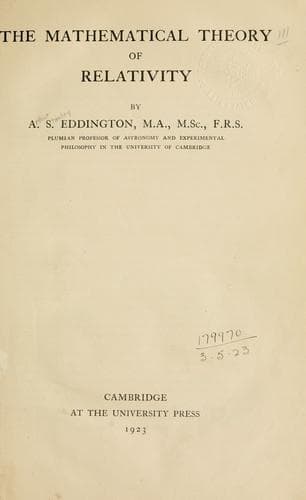
The Mathematical Theory of RelativityEddington, Arthur Stanley, Sir
Science
The Mathematical Theory of Relativity
Eddington, Arthur Stanley, Sir
Relativity (Physics)
Let $A^{\mu}$~be the velocity-vector of the electron ($A^{\mu} = dx_{\mu}/ds$), and $\rho_{0}$~the
proper-density of the charge, then by~\Eq{(73.82)}
\[
J^{\mu} = \rho_{0} A^{\mu},
\Tag{(80.21)}
\]
and
\[
\frac{d^{2}x_{\mu}}{ds^{2}}
+ \{\alpha\beta, \mu\}\, \frac{dx_{\alpha}}{ds}\, \frac{dx_{\beta}}{ds}
= A^{\nu} (A^{\mu})_{\nu},
\Tag{(80.22)}
\]
as in~\Eq{(33.4)}.
Considering the verification of~\Eq{(80.1)} by experiment we remark that $X$ or
$F_{\mu\nu}$ refers to the applied external field, no attention being paid to the possible
disturbance of this field caused by the accelerated electron itself. To distinguish
this we denote the external field by~${F'}_{\mu\nu}$. The equation to be explained
accordingly becomes
\[
mA^{\nu}(A^{\mu})_{\nu} = -{F^{\mu}}_{\nu} (\rho_{0} A^{\nu}),
\]
or, lowering the suffix~$\mu$,
\[
mA^{\nu} A_{\mu\nu} = -{F'^{\mu}}_{\nu} eA^{\nu}.
\Tag{(80.3)}
\]
We have replaced the \emph{density}~$\rho_{0}$ by the \emph{quantity}~$e$ for the reason explained in
the footnote.
Consider now the field due to the electron itself in its own neighbourhood.
This is determined by~\Eq{(74.41)}
\[
\Wave F_{\mu\nu} = J_{\mu\nu} - J_{\nu\mu}
- G_{\mu}^{\epsilon} F_{\epsilon\nu} + G_{\nu}^{\epsilon} F_{\epsilon\mu}
+ 2B_{\mu\nu\alpha\epsilon} F^{\epsilon\alpha}.
\]
The discussion of \SecRef{78} shows that we may safely neglect the gravitational
field caused by the energy of the electron or of the external field. Hence
approximately
\[
\Wave F_{\mu\nu} = J_{\mu\nu} - J_{\nu\mu}.
\]
The solution is as in~\Eq{(74.72)}
\begin{align*}
F_{\mu\nu} &= \int \frac{de\, (A_{\mu\nu} - A_{\nu\mu})}{4\pi\beta r} \\
&= \frac{1}{4\pi\beta}(A_{\mu\nu} - A_{\nu\mu}) \int \frac{de}{r},
\Tag{(80.4)}
\end{align*}
if all parts of the electron have the same velocity~$A^{\mu}$. This result is obtained
primarily for Galilean coordinates; but it is a tensor equation applying to
all coordinate-systems provided that $\int de/r$~is treated as an invariant and
calculated in natural measure. We shall reckon it in proper-measure and
accordingly drop the factor~$\beta$.
\PageSep{191}
Now suppose that the electron moves in such a way that its own field
on the average just neutralises the applied external field~${F'}_{\mu\nu}$ in the region
occupied by the electron. The value of~$F_{\mu\nu}$ averaged for all the elements of
charge constituting the electron is given by
\begin{align*}
eF_{\mu\nu}
&= \frac{1}{4\pi}(A_{\mu\nu} - A_{\nu\mu}) \iint \frac{de_{1}\, de_{2}}{r_{12}} \\
&= \frac{1}{4\pi}(A_{\mu\nu} - A_{\nu\mu}) \frac{e^{2}}{a},
\end{align*}
where $1/a$~is an average value of~$1/r_{12}$ for every pair of points in the electron.
We may leave indeterminate the exact weighting of the pairs of points in
taking the average, merely noting that $a$~will be a length comparable with
the radius of the sphere throughout which the charge (or the greater part of
it) is spread.
Public-domain text, read in full here on John Shaqi.
Reviews
Reviews
No reviews yet
Be the first to share your thoughts on this work.
Elsewhere in the archive
Join the Discussion
Join the discussion
Sign in to leave a comment or review.
Sign InorCreate an account