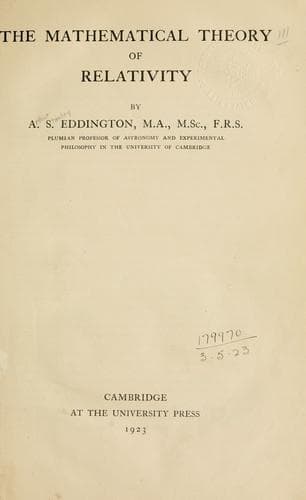
The Mathematical Theory of RelativityEddington, Arthur Stanley, Sir
Science
The Mathematical Theory of Relativity
Eddington, Arthur Stanley, Sir
Relativity (Physics)
Accordingly $m_{g}/m_{e}$~is a constant of nature and it may be absorbed in
equation~\Eq{(80.8)} by properly choosing the unit of~$F_{\mu\nu}$.
\Section{81.}{Electromagnetic volume}
If $a_{\mu\nu}$~is any tensor, the determinant~$|a_{\mu\nu}|$ is transformed according to the
law
\[
|a_{\mu\nu}| = J^{2} |a_{\mu\nu}'|
\]
\PageSep{194}
by~\Eq{(48.8)}, whence it follows as in~\Eq{(49.3)} that
\[
\int \Chg{\surd(|a_{\mu\nu}|)}{\sqrt{|a_{\mu\nu}|}}\, d\tau
\Tag{(81.1)}
\]
for any four-dimensional region is an invariant.
We have already considered the case a $a_{\mu\nu} = g_{\mu\nu}$, and it is natural now to
consider the case $a_{\mu\nu} = F_{\mu\nu}$. Since the tensor~$g_{\mu\nu}$ defines the metric of space-time,
and the corresponding invariant is the metrical volume (natural volume)
\index{Electromagnetic action!volume}%
\index{Volume!electromagnetic}%
of the region, it seems appropriate to call the invariant
\[
V_{e} = \int \Chg{\surd(|F_{\mu\nu}|)}{\sqrt{|F_{\mu\nu}|}}\, d\tau
\Tag{(81.2)}
\]
the electromagnetic volume of the region. The resemblance to metrical volume
is purely analytical.
Since $|F_{\mu\nu}|$~is a skew-symmetric determinant of even order, it is a perfect
square, and \Eq{(81.2)}~is rational. It easily reduces to
\[
V_{e} = \int (F_{23} F_{14} + F_{31} F_{24} + F_{12} F_{34})\, d\tau.
\Tag{(81.31)}
\]
In Galilean coordinates this becomes
\[
V_{e} = \int (\alpha X + \beta Y + \gamma Z)\, d\tau.
\Tag{(81.32)}
\]
It is somewhat curious that the scalar-product of the electric and magnetic
forces is of so little importance in the classical theory, for \Eq{(81.32)} would seem
to be the most fundamental invariant of the field. Apart from the fact that
it vanishes for electromagnetic waves propagated in the absence of any bound
electric field (i.e.\ remote from electrons), this invariant seems to have no significant
properties. Perhaps it may turn out to have greater importance when
the study of electron-structure is more advanced.
From~\Eq{(81.31)} we have
\begin{align*}
V_{e}
&= \int \sum \left(\frac{\dd\kappa_{1}}{\dd x_{4}}\, \frac{\dd\kappa_{2}}{\dd x_{3}}
- \frac{\dd\kappa_{1}}{\dd x_{3}}\, \frac{\dd\kappa_{2}}{\dd x_{4}}\right) d\tau
\intertext{the summation being for all permutations of the suffixes}
&= \int \sum \left\{\frac{\dd}{\dd x_{4}} \left(\kappa_{1}\, \frac{\dd\kappa_{2}}{\dd x_{3}}\right)
- \frac{\dd}{\dd x_{3}} \left(\kappa_{1}\, \frac{\dd\kappa_{2}}{\dd x_{4}}\right)\right\} d\tau.
\end{align*}
Hence $V_{e}$~reduces to a surface-integral over the boundary of the region, and
it is useless to consider its variations by the Hamiltonian method. The electromagnetic
volume of a region is of the nature of a flux through its three-dimensional
boundary.
\Section{82.}{Macroscopic equations}
\index{Macroscopic electromagnetic equations}%
Public-domain text, read in full here on John Shaqi.
Reviews
Reviews
No reviews yet
Be the first to share your thoughts on this work.
Elsewhere in the archive
Join the Discussion
Join the discussion
Sign in to leave a comment or review.
Sign InorCreate an account