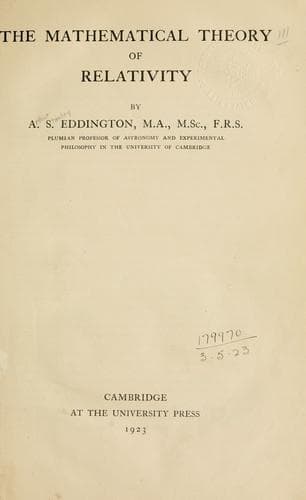
The Mathematical Theory of RelativityEddington, Arthur Stanley, Sir
Science
The Mathematical Theory of Relativity
Eddington, Arthur Stanley, Sir
Relativity (Physics)
For macroscopic treatment the distribution and motion of the electrons are
averaged, and the equivalent continuous distribution is described by two new
quantities
\begin{align*}
&\text{the electric displacement, $P$, $Q$, $R$,} \\
&\text{the magnetic induction, $a$, $b$, $c$,}
\end{align*}
\PageSep{195}
in addition to
\begin{align*}
&\text{the electric force, $X$, $Y$, $Z$,} \\
&\text{the magnetic force, $\alpha$, $\beta$, $\gamma$.}
\end{align*}
These are grouped cross-wise to form the two principal electromagnetic tensors
\[
F_{\mu\nu} = \begin{array}[t]{@{}r@{\Add{,}\quad}r@{\Add{,}\quad}r@{\Add{,}\quad}r@{}}
0 & -c & b & -X\Add{,} \\
c & 0 & -a & -Y\Add{,} \\
-b & a & 0 & -Z\Add{,} \\
X & Y & Z & 0\Add{,} \\
\end{array}\qquad
H^{\mu\nu} = \begin{array}[t]{@{}r@{\Add{,}\quad}r@{\Add{,}\quad}r@{\Add{,}\quad}r@{}}
0 & -\gamma & \beta & \Neg P\Add{,} \\
\gamma & 0 & -\alpha & Q\Add{,} \\
-\beta & \alpha & 0 & R\Add{,} \\
-P & -Q & -R & 0. \\
\end{array}
\Tag{(82.1)}
\]
$H^{\mu\nu}$~now plays the part previously taken by~$F^{\mu\nu}$; but it is no longer derived
from~$F_{\mu\nu}$ by a mere raising of suffixes. The relation between the two tensors
is given by the constitutive equations of the material; in simple cases it is
\index{Constitutive equations}%
specified by two constants, the specific inductive capacity~$\kappa$ and the permeability~$\mu$.
\index{Permeability, magnetic}%
Equations \Eq{(73.73)} and~\Eq{(73.74)} are replaced by
\[
\left.
\begin{aligned}
F_{\mu\nu} &= \frac{\dd\kappa_{\mu}}{\dd x_{\nu}} - \frac{\dd\kappa_{\nu}}{\dd x_{\mu}}\Add{,} \\
H_{\nu}^{\mu\nu} &= J^{\mu}.
\end{aligned}
\right\}
\Tag{(82.2)}
\]
These represent the usual equations of the classical theory. It should be
noticed that $\dd H/\dd y - \dd G/\dd z$ is now~$a$, not~$\alpha$.
In the simple case the constitutive equations are
\[
(P, Q, R) = K(X, Y, Z);\quad (a, b, c) = \mu(\alpha, \beta, \gamma),
\Tag{(82.3)}
\]
so that
%[** TN: Not broken in the original]
\begin{gather*}
H^{11}, H^{12}\Add{,} \dots\Add{,} H^{33}
= \frac{1}{\mu}(F^{11}, F^{12}\Add{,} \dots\Add{,} F^{33});\displaybreak[0] \\
H^{14}, H^{24}, H^{34} = K(F^{14}, F^{24}, F^{34}).
\end{gather*}
These simplified equations are not of tensor form, and refer only to coordinates
with respect to which the material is at rest. For general coordinates the
constitutive equations must be of the form
\[
H^{\mu\nu} = p^{\mu\alpha} p^{\nu\beta} F_{\alpha\beta},
\]
where $p^{\mu\nu}$~is a tensor.
The law of conservation of electric charge can be deduced from $H_{\nu}^{\mu\nu} = J^{\mu}$
just as in~\Eq{(73.76)}.
Public-domain text, read in full here on John Shaqi.
Reviews
Reviews
No reviews yet
Be the first to share your thoughts on this work.
Elsewhere in the archive
Join the Discussion
Join the discussion
Sign in to leave a comment or review.
Sign InorCreate an account